
Articles by Lisa Zyga

Phys.org / Researchers build first deployable, walking, soft robot
(Phys.org)—Researchers have built the first robot made of soft, deployable materials that is capable of moving itself without the use of motors or any additional mechanical components. The robot "walks" when an electric current ...

Phys.org / 3-in-1 device offers alternative to Moore's law
In the semiconductor industry, there is currently one main strategy for improving the speed and efficiency of devices: scale down the device dimensions in order to fit more transistors onto a computer chip, in accordance ...

Phys.org / Physicists use quantum memory to demonstrate quantum secure direct communication
For the first time, physicists have experimentally demonstrated a quantum secure direct communication (QSDC) protocol combined with quantum memory, which is essential for storing and controlling the transfer of information. ...

Phys.org / Solving systems of linear equations with quantum mechanics
(Phys.org)—Physicists have experimentally demonstrated a purely quantum method for solving systems of linear equations that has the potential to work exponentially faster than the best classical methods. The results show ...

Phys.org / For storing energy from renewable sources, scientists turn to antiferroelectrics
(Phys.org)—One of the greatest challenges in generating energy from renewable sources is finding a way to store the continuously fluctuating energy being produced. Batteries, supercapacitors, and most other energy-storage ...

Phys.org / New magnetoresistance effect leads to four-state memory device
(Phys.org)—In 2015, scientists discovered a new magnetoresistance effect—that is, a new way in which magnetization affects a material's electric resistance—but hadn't yet found a promising application for the discovery, beyond ...

Phys.org / Researchers investigate decision-making by physical phenomena
(Phys.org)—Decision-making is typically thought of as something done by intelligent living things and, in modern times, computers. But over the past several years, researchers have demonstrated that physical objects such ...

Phys.org / Diamond needles emit intense bunches of electrons when illuminated by light
(Phys.org)—For the first time, researchers have demonstrated that shining a nanosecond pulsed laser at the base of a 100-µm-long diamond needle can significantly enhance electron emission from the tip of the needle. The ability ...

Phys.org / Physicists uncover similarities between classical and quantum machine learning
(Phys.org)—Physicists have found that the structure of certain types of quantum learning algorithms is very similar to their classical counterparts—a finding that will help scientists further develop the quantum versions. ...

Phys.org / Phase transitions of rice farmers may offer insight into managing natural resources
(Phys.org)—The Balinese subak is a self-organized agrarian society on the island of Bali in Indonesia, whose members must share a limited amount of water for irrigation and rice production. Some of the farmers share the water ...

Phys.org / Understanding how slow predators catch faster prey could improve drone tactics
(Phys.org)—Since a gazelle can run faster than a lion, how do lions ever catch gazelles? A new model of predator-prey interaction shows how groups of predators use collective chasing strategies, such as cornering and circling, ...

Phys.org / New blackbody force depends on spacetime geometry and topology
(Phys.org)—In 2013, a group of physicists from Austria proposed the existence of a new and unusual force called the "blackbody force." Blackbodies—objects that absorb all incoming light and therefore appear black at room ...
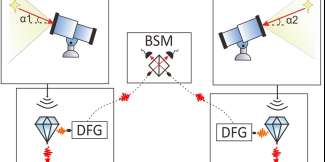
Phys.org / Stars as random number generators could test foundations of physics
(Phys.org)—Stars, quasars, and other celestial objects generate photons in a random way, and now scientists have taken advantage of this randomness to generate random numbers at rates of more than one million numbers per ...

Phys.org / Physicists predict supercurrent driven by potential information transfer
(Phys.org)—Physicists have theoretically shown that a superconducting current of electrons can be induced to flow by a new kind of transport mechanism: the potential flow of information. This unusual phenomenon is predicted ...

Phys.org / Scientists solve 400-year-old mystery of Prince Rupert's drops
(Phys.org)—Researchers have finally answered a question that has stumped scientists since the early 1600s: Why are the heads of tadpole-shaped pieces of glass called "Prince Rupert's drops" so strong?
