
Articles by Lisa Zyga

Phys.org / Researchers develop 'MicroMegascope': imaging with a tuning fork
Currently, atomic force microscopes (AFMs) are one of the most widely used tools for imaging, measuring, and manipulating matter at the nanoscale. One of the key components of an AFM is a microscale oscillator, which scans ...

Phys.org / Self-replicator that is simultaneously created and destroyed may lead to better understanding of life
As living organisms eat, grow, and self-regenerate, all the while they are slowly dying. Chemically speaking, this is because life is thermodynamically unstable, while its ultimate waste products are in a state of thermal ...

Phys.org / Physicists show that it is impossible to mask quantum information in correlations
Information is typically stored in physical systems, such as memory devices. But in a new study, physicists have investigated an alternative way to store and hide information, which is by storing it only in the quantum correlations ...

Phys.org / Braiding may be key to using time crystals in quantum computing
Over the past few years, physicists have predicted that a new form of matter called time crystals may have potential applications in quantum computing. Now in a new study, physicists Raditya Weda Bomantara and Jiangbin Gong ...

Phys.org / Future quantum technologies may exploit identical particle entanglement
Usually when physicists perform quantum entanglement between particles—whether it be qubits, atoms, photons, electrons, etc.—the particles are distinguishable in some way. Only recently have physicists demonstrated the feasibility ...
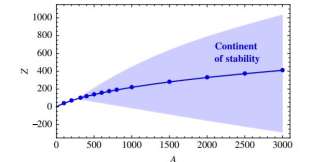
Phys.org / New form of matter may lie just beyond the periodic table
Currently, the heaviest element on the periodic table is oganesson, which has an atomic mass of 294 and was officially named in 2016. Like every element on the periodic table, nearly all of oganesson's mass comes from protons ...

Phys.org / Harmonic oscillator's most 'classical-like' state exhibits nonclassical behavior
Showing just how blurry the boundary is between the quantum and classical worlds, physicists in a new study have theoretically demonstrated that a macroscopic oscillating object initially in a classical-like coherent state ...

Phys.org / Quantum stopwatch stores time in a quantum memory
Physicists have developed a "quantum stopwatch"—a method that stores time (in the form of states of quantum clocks) in a quantum memory. In doing so, the method avoids the accumulation of errors that usually occurs when measuring ...

Phys.org / Compact 3-D quantum memory addresses long-standing tradeoff
Physicists have designed a 3-D quantum memory that addresses the tradeoff between achieving long storage times and fast readout times, while at the same time maintaining a compact form. The new memory has potential applications ...

Phys.org / How a particle may stand still in rotating spacetime
When a massive astrophysical object, such as a boson star or black hole, rotates, it can cause the surrounding spacetime to rotate along with it due to the effect of frame dragging. In a new paper, physicists have shown that ...

Phys.org / How can you tell if a quantum memory is really quantum?
Quantum memories are devices that can store quantum information for a later time, which are usually implemented by storing and re-emitting photons with certain quantum states. But often it's difficult to tell whether a memory ...

Phys.org / Giant molecules shaped like Kandinsky circles are toxic to MRSA bacteria
Nested structures are commonly found throughout nature and art, whether they be in the form of tree rings, Russian dolls, or Wassily Kandinsky's famous 1913 abstract painting Color Study: Squares with Concentric Circles. ...

Phys.org / Stronger-than-binary correlations experimentally demonstrated for the first time
For the first time, physicists have experimentally demonstrated ternary—rather than binary—quantum correlations between entangled objects. The results show that the quantum measurement process cannot be described as a binary ...

Phys.org / Magnonic interferometer paves way toward energy-efficient information processing devices
Researchers have designed an interferometer that works with magnetic quasiparticles called magnons, rather than photons as in conventional interferometers. Although magnon signals have discrete phases that normally cannot ...

Phys.org / New quantum probability rule offers novel perspective of wave function collapse
Quantum theory is based heavily on probabilities, since measuring a quantum system doesn't produce the same outcome every time, but instead yields one of many outcomes that each occur with a certain probability. Now in a ...
