
Articles by Sam Jarman

Phys.org / Dark energy and quantum gravity may be deeply intertwined
For close to a century, physicists have pursued a way to unite gravity with quantum mechanics. Known as quantum gravity, this goal has remained frustratingly out of reach so far. Similarly elusive is the force of dark energy, ...

Phys.org / Physicists entangle quantum memories across a record-breaking 420 km
Optical fibers are already the backbone of global communication systems. Recently, however, physicists have started to explore how their functionality could be boosted further by conveying information via entangled quantum ...

Phys.org / Ruby-forming mineral found by Mars rover hints at violent impacts
So far, most of the minerals found on Mars tell a story of lava poured out by ancient volcanoes, followed by long stretches in which water trickled through and slowly reshaped the rock. However, some rocks scattered across ...

Phys.org / Dark matter may be gravitationally lensing a likely source of cosmic neutrinos
Astronomers have discovered that the jet of a distant blazar has been gravitationally lensed by an unseen source of dark matter. Led by Silke Britzen at the Max Planck Institute for Radio Astronomy in Germany, the team's ...

Phys.org / Strain flips Hall signal in altermagnetic manganese telluride, suggesting a path to practical spintronics
Time-reversal symmetry is an exotic behavior found in systems whose internal physics looks different when running forward versus backward in time. For some time, physicists have searched for this behavior in systems with ...
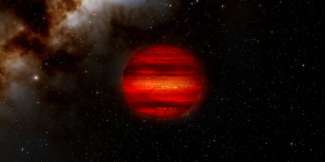
Phys.org / TESS discovers a rare brown dwarf orbiting a massive, aging star
For decades, astronomers lumped brown dwarfs into a single category defined by mass alone—too big to be classified as planets but too small to become stars. However, this definition ignores the two very different mechanisms ...

Phys.org / Satellite constellations could create spiraling space debris
To date, close to 30,000 satellites have been launched into Earth's orbit, leading to mounting concerns over the debris created when they collide. In a new analysis posted to the preprint server arXiv, Hugh Lewis of the University ...

Phys.org / Mars could have carried liquid water more recently than we thought
For decades, astronomers have assumed that the Martian surface froze solid around 3 billion years ago and has stayed that way ever since. If this were really the case, any liquid water would have long since either been locked ...

Phys.org / Cosmic filaments help set first limits on dark matter's decay into gravitons
Composing some 85% of the universe's total mass, dark matter betrays its presence only through gravity, unlike ordinary matter. Yet through new research published in Physical Review D, a team led by David Dunsky of New York ...

Phys.org / Galactic spins carry fingerprints of the primordial universe
The origin of spin in spiral and elliptical galaxies has posed a long-standing puzzle for astronomers. One idea, known as tidal torque theory, proposes that galaxies' spins are an imprinted record of the early universe, imparted ...

Phys.org / XENONnT detector narrows the hunt for dark matter
Using a detector filled with nearly 9 metric tons of liquid xenon, researchers have delivered some of the most sensitive dark matter results ever recorded. In the latest analysis from the XENON collaboration, working at the ...

Phys.org / Venus's polygonal plains could point to a watery past
Venus may be overwhelmingly inhospitable today, but many planetary scientists believe that it wasn't always this way. Billions of years ago, some observational evidence suggested that our planetary neighbor may have looked ...

Phys.org / Asteroid Nysa's rare three-lobed structure challenges formation models
Named for the mythical valley where the god Dionysus was raised in secret by nymphs, the asteroid 44 Nysa inhabits the asteroid belt between Mars and Jupiter. Through observations by the Hubble Space Telescope, astronomers ...

Phys.org / Simulations hint at a hidden population of companionless black holes
So far, almost all stellar-mass black holes detected by astronomers have been found in binary systems. However, astronomers have long suspected that these binary black holes are the exception and that, within the Milky Way, ...

Phys.org / DESI side project reveals the spectra of disintegrated exoplanets
Using spectral data from the Dark Energy Spectroscopic Instrument (DESI), astronomers have gained some of the clearest evidence yet that white dwarf stars are accreting debris from disintegrating exoplanets. Captured while ...
