
Articles by Tejasri Gururaj

Phys.org / First detection of cross-correlation between cosmic shear and X-ray background enhances baryonic matter understanding
A new study in Physical Review Letters offers the first detection of the cross-correlation between cosmic shear and diffuse X-ray background, helping to understand the distribution of baryonic matter in the universe.

Medical Xpress / Scientists uncover the role of dopamine in mediating short-term and long-term memory dynamics
In a recent study published in Nature, researchers from Stanford University and Yale University have explored the interplay between short-term and long-term memory in animals.

Phys.org / Scientist performs the first nonlinear study of black hole mimickers
In recent research, a scientist from Princeton University has performed the first nonlinear study of the merger of a black hole mimicker, aiming to understand the nature of gravitational wave signals emitted by these objects, ...

Phys.org / New study uses self-interacting dark matter to solve the final parsec problem
In a new study, scientists from Canada have proposed a solution to the final parsec problem of supermassive black hole (SMBH) mergers using self-interacting dark matter.

Phys.org / Scientists integrate solid-state spin qubits with nanomechanical resonators
In a new Physical Review Letters study, scientists propose a new method for combining solid-state spin qubits with nanomechanical resonators for scalable and programmable quantum systems.

Phys.org / Scientists demonstrate chemical reservoir computation using the formose reaction
Researchers from the Institute for Molecules and Materials at Radboud University, Netherlands, have demonstrated that a complex self-organizing chemical reaction network can perform various computational tasks, such as nonlinear ...

Phys.org / Modeling study proposes a diamond layer at the core-mantle boundary on Mercury
A recent study in Nature Communications by scientists from China and Belgium suggests that Mercury's core-mantle boundary (CMB) includes a diamond layer, potentially up to 18 kilometers thick, deep within the planet's interior.

Phys.org / Photons from quantum dot emitters violate Bell inequality in new study
A new study in Nature Physics demonstrates a novel method for generating quantum entanglement using a quantum dot, which violates the Bell inequality. This method uses ultra-low power levels and could pave the way for scalable ...

Phys.org / Foregoing quantum chaos to achieve high-fidelity quantum state transfer
An international team of scientists from China and the U.S. has developed a scalable protocol for high-fidelity quantum state transfer (QST) in a 36-qubit superconducting quantum circuit.

Phys.org / High-temperature superconductivity: Exploring quadratic electron-phonon coupling
A new study published in Physical Review Letters (PRL) explores the potential of quadratic electron-phonon coupling to enhance superconductivity through the formation of quantum bipolarons.

Phys.org / Supercooled phase transitions: Could they explain gravitational wave signals?
A new study published in Physical Review Letters explores the possibility that a strongly supercooled, first-order phase transition in the early universe could explain gravitational wave signals observed by pulsar timing ...

Phys.org / New theory links quantum geometry to electron-phonon coupling
A new study published in Nature Physics introduces a theory of electron-phonon coupling that is affected by the quantum geometry of the electronic wavefunctions.

Phys.org / Pseudomagic quantum states: A path to quantum supremacy
A new study in Physical Review Letters (PRL) introduces the concept of pseudomagic quantum states, which appear to have high stabilizerness (or complexity) and can move us closer to achieving quantum supremacy.

Phys.org / Into the abyss: Understanding black hole formation through natal kicks and neutrino emission
A new study in Physical Review Letters explores the conditions of black hole formation from dying stars, particularly the role of neutrino-induced natal kicks in the formation process.
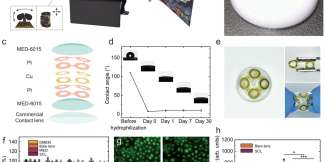
Tech Xplore / Eyes of tomorrow: Smart contact lenses lead the way for human-machine interaction
Scientists from Nanjing, China, have developed eye-tracking smart content lenses based on radio frequency tags that can be used for various applications, including health care and augmented reality (AR). The lenses are biocompatible ...
