
Articles by Tomasz Nowakowski

Phys.org / REBELS-25 is a dynamically cold disk galaxy, observations find
An international team of astronomers has observed a high-redshift massive star-forming galaxy known as REBELS-25. They found that REBELS-25 is a dynamically cold disk galaxy. This finding was presented in a research paper ...

Phys.org / Three new RR Lyrae variable stars discovered
Using the Lulin One-meter Telescope (LOT), astronomers have observed a newly detected candidate ultra-faint dwarf galaxy known as Virgo III. As a result, they discovered three new RR Lyrae variable stars in the vicinity of ...

Phys.org / Astronomers discover merging twin quasars
Using the Subaru Telescope in Hawaii, astronomers have detected a pair of merging quasars at a high redshift, as part of the Hyper SuprimeCam (HSC) Subaru Strategic Program (SPP) survey. The serendipitous discovery is reported ...

Phys.org / Supernova SN 2023fyq exhibited long-lasting pre-explosion activity, observations show
An international team of astronomers have performed photometric and spectroscopic observations of a Type Ibn supernova, known as SN 2023fyq. Results of the observations campaign, published May 7 on the pre-print server arXiv, ...

Phys.org / Raspberry in the sky: Astronomers discover a new supernova remnant candidate
Astronomers from the Western Sydney University in Australia and elsewhere report the detection of a new supernova remnant (SNR) candidate. The newfound SNR candidate, dubbed "Raspberry" due to its morphology, was identified ...

Phys.org / Research investigates the environment of globular cluster NGC 6355
Using the Dark Energy Camera (DECam), Argentinian astronomers have investigated the environment of a galactic globular cluster known as NGC 6355. The study, presented in a paper published May 2 on the pre-print server arXiv, ...

Phys.org / Astronomers explore globular cluster NGC 2419
Using the Indian Astronomical Observatory (IAO) and ESA's Gaia satellite, astronomers have explored a galactic globular cluster known as NGC 2419. Results of the study, published April 29 on the preprint server arXiv, shed ...

Phys.org / New accreting millisecond X-ray pulsar discovered
Astronomers report the discovery of a new pulsar using the Spektr-RG space observatory. The newfound object, designated SRGA J144459.2−604207 (or SRGA J1444 for short), turns out to be a bursting accreting millisecond X-ray ...

Phys.org / Study investigates a nearby M-dwarf binary system
Using the Very Long Baseline Array (VLBA), astronomers have explored a nearby binary stellar system composed of two M dwarfs, known as LP 349−25AB. Results of the study, presented April 25 on the pre-print server arXiv, shed ...

Phys.org / Astronomers inspect population of young stellar objects in open cluster NGC 346
Using the James Webb Space Telescope (JWST), an international team of astronomers has explored young stellar objects (YSOs) in an open cluster known as NGC 346. The study, published April 24 on the preprint server arXiv, ...

Phys.org / TOI-837 b is a young Saturn-sized exoplanet with a massive core, observations find
European astronomers have performed photometric and spectroscopic observations of a distant giant exoplanet known as TOI-837 b. As a result, they found that TOI-837 b is a young Saturn-sized planet containing a massive core, ...

Phys.org / Researchers explore an old galactic open cluster
Using data from ESA's Gaia satellite, astronomers from Turkey and India have investigated NGC 188—an old open cluster in the Milky Way. Results of the study, published April 19 on the pre-print server arXiv, deliver important ...

Phys.org / Tidal disruption event ASASSN-19bt experiences unusual radio evolution, observations show
An international team of astronomers has conducted detailed radio and X-ray observations of a tidal disruption event (TDE) designated ASASSN-19bt. Results of the observational campaign, presented April 18 on the pre-print ...
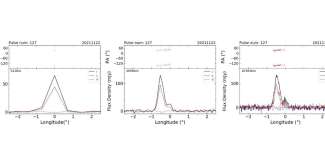
Phys.org / Research investigates radio emission of the rotating radio transient RRAT J1854+0306
Using the Five-hundred-meter Aperture Spherical radio Telescope (FAST), Chinese astronomers have investigated radio emission from a rotating radio transient known as RRAT J1854+0306. Results of the study, published April ...

Phys.org / Recently discovered black hole is part of a nearby disrupted star cluster, study finds
European astronomers have investigated a recently detected black hole designated Gaia BH3. In their results, they found that the black hole is associated with a nearby disrupted star cluster known as ED-2. The finding is ...
