
Articles by Lisa Zyga

Phys.org / Brain-computer interface could improve hearing aids
(Phys.org)—Researchers are working on the early stages of a brain-computer interface (BCI) that can tell who you're listening to in a room full of noise and other people talking. In the future, the technology could be incorporated ...

Phys.org / Microbes may encourage altruistic behavior
(Phys.org)—Why do people commonly go out of their way to do something nice for another person, even when it comes at a cost to themselves—and how could such altruistic behavior have evolved? The answer may not just be in ...

Phys.org / Violations of energy conservation in the early universe may explain dark energy
(Phys.org)—Physicists have proposed that violations of energy conservation in the early universe, as predicted by certain modified theories of quantum mechanics and quantum gravity, may explain the cosmological constant problem, ...

Phys.org / Graphene photodetector enhanced by fractal golden 'snowflake'
(Phys.org)—Researchers have found that a snowflake-like fractal design, in which the same pattern repeats at smaller and smaller scales, can increase graphene's inherently low optical absorption. The results lead to graphene ...

Phys.org / Semiconducting nanonetwork could form the backbone of transparent, flexible electronics
(Phys.org)—Researchers may have found a "sweet spot" for organic electronics by fabricating a new 2D semiconducting polymer-blended nanonetwork material that simultaneously achieves excellent charge mobility, high flexibility, ...

Phys.org / Scientists create first 2-D electride
(Phys.org)—Researchers have brought electrides into the nanoregime by synthesizing the first 2D electride material. Electrides are ionic compounds, which are made of negative and positive ions. But in electrides, the negative ...
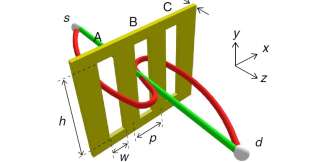
Phys.org / Physicists detect exotic looped trajectories of light in three-slit experiment
(Phys.org)—Physicists have performed a variation of the famous 200-year-old double-slit experiment that, for the first time, involves "exotic looped trajectories" of photons. These photons travel forward through one slit, ...

Phys.org / Cryogenic test probes Einstein's equivalence principle, general relativity, and spacetime 'foam'
(Phys.org)—Physicists have performed a test designed to investigate the effects of the expansion of the universe—hoping to answer questions such as "does the expansion of the universe affect laboratory experiments?", "might ...

Phys.org / Multiple copies of the Standard Model could solve the hierarchy problem
(Phys.org)—One of the unanswered questions in particle physics is the hierarchy problem, which has implications for understanding why some of the fundamental forces are so much stronger than others. The strengths of the forces ...

Phys.org / Nano system operates with interacting electrons, but no electric current
(Phys.org)—Illustrating the unusual way things work on the nanoscale, scientists have designed a new nanoelectromechanical system (NEMS) that produces mechanical motion due to the interactions between electrons—yet unlike ...

Phys.org / Still no violation of Lorentz symmetry, despite strongest test yet
(Phys.org)—Physicists have found the strongest evidence yet for no violation of Lorentz symmetry, one of the fundamental symmetries of relativity. Lorentz symmetry states that the outcome of an experiment does not depend ...

Phys.org / Synthesis of pseudo-1D semiconductor provides insight into anisotropic 2D materials
(Phys.org)—For the first time, researchers have synthesized semiconducting gallium telluride (GaTe) in the monoclinic phase as a pseudo-one-dimensional (pseudo-1D) material. This new class of materials is characterized by ...

Phys.org / Weak-value-based metrology surpasses classical limit
(Phys.org)—When measuring very small physical effects, such as the deflection of a light beam, the very act of measuring can affect the measurement outcome. Now in a new study, physicists have experimentally demonstrated ...

Phys.org / Encounters with 'familiar strangers' play overlooked role in human interactions
(Phys.org)—According to a new study, there are more familiar strangers in our lives than friends, coworkers, and all other acquaintances combined. Encounters with familiar strangers, defined as pairs of individuals who repeatedly ...

Phys.org / Particles self-assemble into Archimedean tilings
(Phys.org)—For the first time, researchers have simulated particles that can spontaneously self-assemble into networks that form geometrical arrangements called Archimedean tilings. The key to realizing these structures is ...
