
Articles by Lisa Zyga

Phys.org / Nanophotonic light sails may travel at relativistic speeds
One day in the not-so-distant future, light sails may hurtle through space at speeds of around 20% of the speed of light (or 60,000 km/sec), propelled not by fuel but rather by the radiation pressure from high-power lasers ...

Phys.org / Physicists experimentally verify 40-year-old fluid equations
For decades, researchers have been using equations derived in the mid-1970s for a variety of fluid applications involving inks, foams, and bubbles, among other uses. These fundamental fluid equations describe how much force ...

Phys.org / Researchers develop sub-7-nm memory device without nanofabrication
Scientists have developed some of the tiniest magnets to date, just 3-7 nanometers (nm) in size. Due to their small dimensions and high thermal stability, as well as the simple self-assembly process used to make them, the ...

Phys.org / Gravitational wave detectors to search for dark matter
Gravitational wave detectors might be able to detect much more than gravitational waves. According to a new study, they could also potentially detect dark matter, if dark matter is composed of a particular kind of particle ...

Phys.org / Chemo spray may offer alternative to conventional chemotherapy
Chemotherapy is often used as a follow-up treatment after surgical removal of a cancerous tumor in order to destroy any remaining cancer cells, but intravenous chemo drugs have notorious side effects and are not always effective.
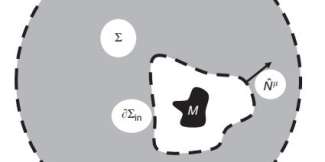
Phys.org / Study finds flaw in emergent gravity
In recent years, some physicists have been investigating the possibility that gravity is not actually a fundamental force, but rather an emergent phenomenon that arises from the collective motion of small bits of information ...

Phys.org / How did genetic parasites overcome natural selection for billions of years?
Nearly half of the human genome is composed of genetic parasites—transposons, plasmids, viruses, and other genetic elements that have one thing in common: they don't make any beneficial contributions to their hosts, and can ...

Phys.org / New materials undergo solid-liquid phase transitions at room temperature
Researchers have developed the first materials that can permanently change from solid to liquid, or vice versa, when exposed to light at room temperature, and remain in the new phase even after the light is removed. The researchers ...

Phys.org / Holographic image of a black hole proposed in a graphene flake
Physicists have theoretically shown that, by applying a magnetic field to a small, irregularly shaped graphene flake, the flake becomes a quantum hologram of a black hole. This means that the graphene flake recreates the ...

Phys.org / Unusual sound waves discovered in quantum liquids
Ordinary sound waves—small oscillations of density—can propagate through all fluids, causing the molecules in the fluid to compress at regular intervals. Now physicists have theoretically shown that in one-dimensional quantum ...

Phys.org / Hybrid device harvests both mechanical and magnetic energy
A new hybrid energy-harvesting device may one day replace the need for batteries in certain low-power electronics devices. The new device collects ambient wasted energy from both mechanical vibrations and magnetic fields ...

Phys.org / Smart window controls light and heat, kills microorganisms
A new smart window offers more than just a nice view—it also controls the transmittance of sunlight, heats the interiors of buildings by converting solar radiation into heat, and virtually eliminates E. coli bacteria living ...

Phys.org / Parrondo's paradox with a three-sided coin
Physicists have demonstrated that Parrondo's paradox—an apparent paradox in which two losing strategies combine to make a winning strategy—can emerge as a coin game with a single coin in the quantum realm, but only when the ...

Phys.org / 18-qubit entanglement sets new record
Physicists have experimentally demonstrated 18-qubit entanglement, which is the largest entangled state achieved so far with individual control of each qubit. As each qubit has two possible values, the 18 qubits can generate ...

Phys.org / Skyrmion reshuffler comes to the aid of stochastic computing
Researchers have designed a "skyrmion reshuffler"—just as a card shuffler shuffles a deck of cards, the skyrmion reshuffler does the same with a type of quasiparticle called magnetic skyrmions. The reshuffler is the first ...
