Best of Last Week – Quantum phase transition observed, lost continent found and the health impact of thirdhand smoke

Quantum phase transition observed for the first time
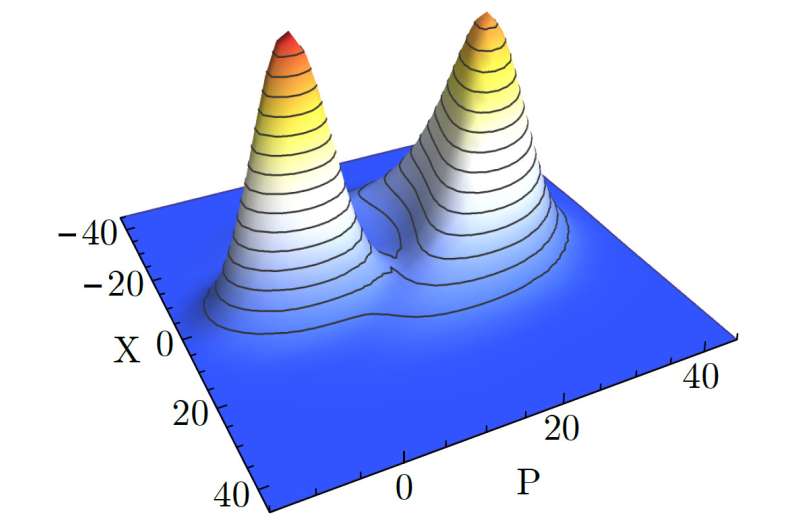
Probability distribution showing the equal likelihood for the cavity being transparent and opaque at the critical point. Credit: J. Fink

(ScienceX)—It was another good week for physics as a team at Brown University pushed the concept of entropy out of kilter by conducting an experiment in which the emergence of a non-equilibrium phenomenon required an entropic assist. Also, a team with members from Switzerland, Austria and Hungary reported on experiments they conducted in which a quantum phase transition was observed for the first time in a dissipative quantum system. And an international team of researchers unveiled the first-ever blueprint to construct a large-scale quantum computer—in addition to offering a means for actually creating such a machine, the design featured a new invention that allows quantum bits to be transmitted between modules.

In news from space, a of researchers with members from Canada, the U.K. and Italy described a study they carried out in which they claimed they found substantial evidence of a holographic universe. Also, NASA released images of close views showing Saturn's rings in unprecedented detail, courtesy of the Cassini space probe. And a team at Northwestern University found a change in an astronaut's gut bacteria attributed to spaceflight—they have been studying the impact of prolonged spaceflight by comparing physical characteristics of twin astronauts Mark and Scott Kelly.

In other news, a trio of researchers with University of the Witwatersrand in South Africa made headlines by announcing that they had confirmed the existence of a 'lost continent' under Mauritius in the Indian Ocean. Also, a team of researchers at Lawrence Berkeley National Laboratory found that third-hand smoke affected weight and blood cell development in micethat were not exposed to smoke, but instead lived in cages that had smoky residue. And a team of from China and the U.K. announced that they had found evidence of a bag-like sea creature that was humans' oldest known ancestor—it lived approximately 540 million years ago in what is now modern China.

And finally, if you are someone who prides themselves on putting in long hours at the office, you might be interested in a report by a team with the Australian National University—they found that a healthy work limit is 39 hours per week—any more than that, they claim, puts people at risk for health problems.

© 2017 ScienceX

Citation: Best of Last Week – Quantum phase transition observed, lost continent found and the health impact of thirdhand smoke (2017, February 6) retrieved 23 April 2026 from https://sciencex.com/news/2017-02-week-quantum-phase-transition-lost.html
This document is subject to copyright. Apart from any fair dealing for the purpose of private study or research, no part may be reproduced without the written permission. The content is provided for information purposes only.

Written for you by our author Bob Yirka—this article is the result of careful human work. We rely on readers like you to keep independent science journalism alive. If this reporting matters to you, please consider a donation (especially monthly).

Latest stories

Honeybees pass their math test, upending an animal intelligence debate

We've run the numbers and the verdict is in: Honeybees do have the ability to process numerical information. New research led by Monash University has now addressed recent international debate over whether bees are truly ...

Unraveling the evolution of leukemia in children with Down syndrome

It may be possible to identify which pre-cancerous cells will develop into a rare type of blood cancer, due to new research showing that a single genetic change drives myeloid leukemia in children with Down syndrome.

A molecular 'cork' reveals how cells control growth

How do cells know when to activate or slow down their activity? A team from the University of Geneva (UNIGE) provides new insights by studying TORC2, an essential but still poorly understood protein complex. Using ultra-high-resolution ...

From public kissing to talking during movies, a simple formula predicts moral norms across cultures

People living in different countries and societies worldwide can have very different views on what behaviors are acceptable. In the field of sociology, these population-level judgments are broadly referred to as moral and ...

In Eastern Africa, the cradle of humankind is tearing apart

Eastern Africa's Turkana Rift is both a hotbed for fossil discoveries of our earliest ancestors and a literal hotbed of volcanic activity caused by shifting tectonic plates. Now researchers have found that Earth's underlying ...

Kakapel rock art traces millennia of painters in Kenya

A recent study published in Azania: Archaeological Research in Africa presents the first millimeter-accurate recording of the paintings at Kakapel rock shelter in Kenya, linking the layers of rock art painted over thousands ...

Promiscuity and parental behavior in birds are driven by demographics, not the other way around

New research shows that variation in mating behaviors, parental care and differences in ornamentation of the sexes in bird species is driven by demographics rather than vice versa. An international team of researchers from ...

Chicken gene-editing advance opens path to drug-producing eggs

Chicken eggs are already used to harvest helpful proteins called antibodies to protect humans from viruses such as influenza. Now, a breakthrough at the University of Missouri could one day lead to chickens that produce other ...

Q&A: Scientists decode the logic behind cells' mysterious protein stockpiles

As far as research subjects go, it's not always easy to find common ground with a single-celled bacterium. Yet the more Paul Wiggins studies his model bacteria, Acinetobacter baylyi, the more he sees surprising commonalities ...

Cosmetics from waste? Microbial discovery unlocks greener route to high-value chemical products

Researchers at University of Toronto's Department of Chemical Engineering & Applied Chemistry have made a key discovery about how certain bacterial strains produce a set of economically valuable chemicals—opening the door ...