Snowball Earth may hide a far stranger climate cycle than anyone expected

Gaby Clark
Scientific Editor

Robert Egan
Associate Editor

Krystal Kasal
Author
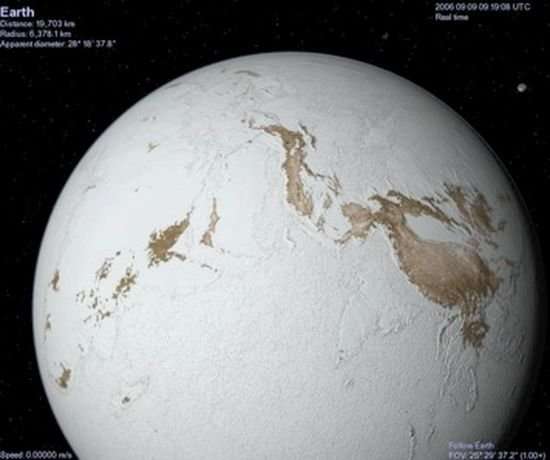
During the Sturtian glacial period during the Neoproterozoic Era, Earth underwent periods of global glaciation, which have been described as either "Snowball" and "Slushball" Earth scenarios. In Snowball Earth models, the planet was completely covered in ice for around 56 million years. In the Slushball models, portions of thin or patchy ice or even open water still existed in the tropics. However, there are some inconsistencies between these models and geological and biological evidence.
A new model, described in a study published in the Proceedings of the National Academy of Sciences, offers an explanation for these inconsistencies. Instead of consistent periods of ice, the new model suggests that cycles of glaciation and warm periods make more sense during the Sturtian period.
Issues with 'Snowball' and 'Slushball' Earth models
The dramatic swings in global temperature that cause periods of glaciation are linked to carbon and oxygen cycles. Another later glacial period, called the Marinoan period, only lasted around 4 million years, far less than the Sturtian. The study authors point out that silicate weathering, which acts as a carbon sink, significantly slows or even shuts down during glaciation. Then volcanic CO2 accumulates until a threshold is reached and the glaciers begin to melt. The team says that the time scale for this cycle is around 4 million years, and even lower in slushball scenarios—consistent with the Marinoan, but not the Sturtian glacial period.

Furthermore, oxygen becomes depleted during long periods of glaciation, and should be completely depleted long before 56 million years of global glacier cover. Yet, some forms of life persisted during the Sturtian glacial period.
"These mismatches between the predicted pCO2 evolution and observed glacial duration, and between the predicted pO2 evolution and observed isotopic and biological records, motivate alternative solutions to the Neoproterozoic glaciation problem," the study authors write.
The Franklin Large Igneous Province and limit cycling
To find a better fitting model for geological and biological observations associated with the Sturtian period, the researchers used a coupled box model to simulate Earth's climate, carbon and oxygen cycles. They tested a range of parameters for volcanic activity, weathering rates and the size of the Franklin Large Igneous Province (LIP). The Franklin LIP is a large igneous rock province in the Canadian Arctic, which researchers think may have helped trigger global glaciation due to significant weathering that used up much of the world's CO2.
"Enhanced weathering by LIPs has long been acknowledged as an important climate driver across geologic time. The Franklin LIP was emplaced at ∼717 Ma, essentially coincident (within 1 to 2 Myr) with the onset of the Sturtian, and could have provided a sufficiently large quantity of fresh basalt to draw down CO2 and trigger a global glaciation," the study authors say.
The team's model showed that the weathering of the Franklin Large Igneous Province triggered repeated cycles of glaciation, where CO2 would build up when LIP weathering halted during glaciation and then CO2 would get depleted by weathering again. According to the model, these "limit cycles" allowed for repeated glaciation over the observed 56-million-year duration and explain how oxygen, and thus life, could persist.
The team writes, "If only a portion of the Franklin LIP was weathered away during the initial Snowball onset, the remaining volume of basalt would still be available for weathering upon deglaciation, reinitiating CO2 drawdown during the interglacial hothouse climate until another Snowball was triggered and the cycle repeated. This cycling, back and forth between climate extremes, would continue until Franklin's weathering power (i.e. unweathered basalt) was exhausted."
While the new model is somewhat simplified and does not capture all possible biogeochemical processes, it puts forth a compelling explanation for some of the outstanding inconsistencies in the Snowball and Slushball Earth explanations. The team says that understanding how repeated Snowball episodes might occur on Earth, can also help scientists understand similar events on Earth-like exoplanets.
