Your brain's inner AI has a wild side, explaining every trippy vision you could imagine

Sadie Harley
Scientific Editor

Robert Egan
Associate Editor

Sayan Tribedi
Author
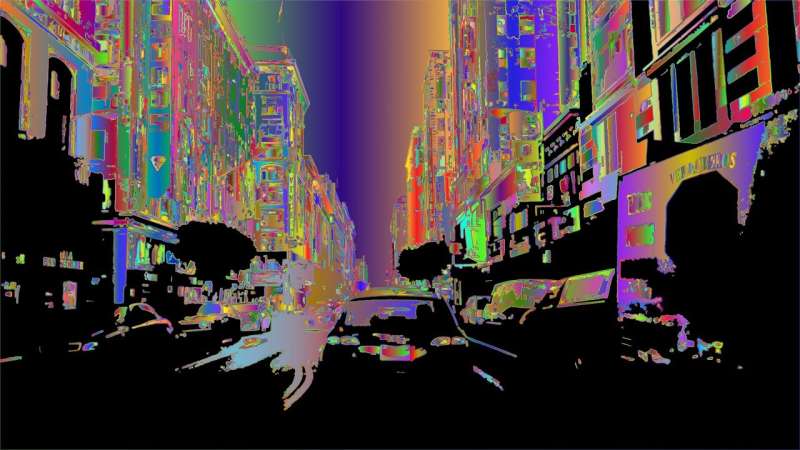
Imagine what would happen if the enigmas of the human brain could be unraveled through technologies developed to replicate its workings. Consider an experience involving spiraling fractal shapes, forming a kaleidoscope of impossible figures. Next, think of meeting an illusory loved one in the flesh, or being menaced by a phantom animal in your midst.
These scenarios involve hallucinations, but their experiential reality can be entirely distinct. Scientists have wondered about this fascinating dichotomy for years—why do experiences under psychedelics produce abstract images, while conditions like dementia and psychosis often give rise to seemingly realistic delusions?
Now, thanks to a revolutionary AI-based model, we have what promises to be a surprisingly simple solution.
Through modeling the brain's perceptual mechanism using a three-fold neural net consisting of a Classifier, a Generator, and a Discriminator, scientists have begun exploring ways in which even the smallest tweaking of the internal mechanism can lead to radical changes in our perception of reality, from bizarre visions to eerie ghost appearances.
Bridging brain and machine
Computational phenomenology tries to link first-person experience with neural models, but most accounts rely on the broad Free Energy Principle (FEP), which can be hard to test.
The new paper, by Keisuke Suzuki, introduces a fresh and highly testable approach. It reimagines the brain's perceptual system not as a single, monolithic entity, but as a sophisticated AI architecture with three distinct, interacting components. The paper is published in the journal Frontiers in Psychology.

The components are: a Classifier (C) that extracts features from sensory input, a Generator (G) that creates internal images, and a Discriminator (D) that judges whether a perception comes from the outside world or the brain itself. Hallucination differences are then explained as changes in these components' goals and constraints.
In this AI-inspired scheme, tweaking each part yields different hallucination styles. Relaxing the Classifier's "filter" lets normally hidden features flood into awareness—much like opening a valve—producing the swirling geometric patterns seen in LSD trips.
By contrast, strengthening the Generator's built-in expectations forces the brain to produce detailed, realistic images (as occurs in dementia and Parkinson's hallucinations), whereas weakening that prior expectation yields more abstract, dreamlike images. The Discriminator acts like a reality-checker: if it fails to veto improbable inputs, bizarre shifting images can emerge (much as in schizophrenia).

Reopening Huxley's 'reducing valve'
Suzuki even revisits Aldous Huxley's famous metaphor. Huxley suggested psychedelics temporarily lift a "valve" that normally blocks most of reality from awareness. In the new model, that valve is real but not mystical—it's a set of neural filters.
"What is revealed when the valve opens is not 'Mind at Large' in the ontological sense but the effective causes learned by Classifier C, computational features that are normally suppressed," Suzuki writes. In other words, opening the valve uncovers the brain's own hidden patterns rather than some cosmic truth.
Testing the theory in the lab
A big advantage of this framework is that it makes clear predictions. The author suggests using deep neural networks and generative adversarial networks (GANs) to simulate hallucinations. For example, one can feed an everyday image into a network repeatedly, watching it warp into a dreamlike scene.
By tuning the network's filters, researchers can "grow" images that look like LSD kaleidoscopes or like the vivid, realistic visions of neurodegenerative hallucinations. These synthetic visions would then be shown to volunteers (for example, in VR goggles) to rate how real or bizarre they seem, linking each type of visual distortion to specific model changes.
Why it matters
Converting personal experience to a model's adjustable parameters has profound consequences. Suzuki observes that the C×G×D paradigm "complements FEP" by offering a physical scaffold that helps convert phenomenology to experimental models. It would allow scientists to recreate altered states without resorting to drugs, as well as enable doctors to profile their patients by identifying which of these parameters is altered in the brain.
In a broader sense, this model establishes the connection between personal experience and neuroscience.
While the current model focuses on the visual sense and remains highly idealistic, it paves the way forward and future research might expand C×G×D onto other senses and even states relating to oneself (e.g., ego dissolution in the case of a deep trip). Should AI learn to decipher our internal visions, we might one day study consciousness without resorting to drugs, while learning what constitutes our reality.
