Tropical cooling points to a world 5.4°C colder at the Ice Age peak

Sadie Harley
Scientific Editor

Robert Egan
Senior Editor

Sayan Tribedi
Author
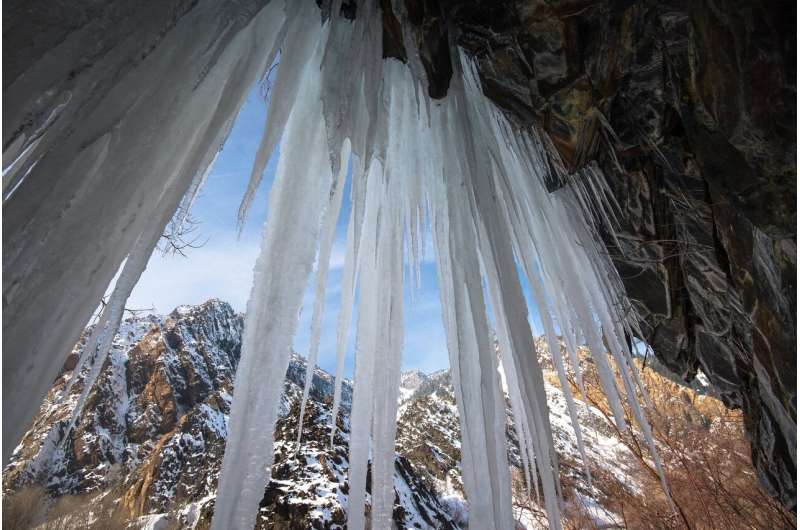
During the Last Glacial Maximum, tropical regions with lush vegetation would have looked completely different. The last Ice Age reached its peak about 20,000–21,000 years ago, and massive ice sheets covered parts of North America, Europe and Asia. Still, understanding how the global climate changed far from the ice sheets is a challenge for paleoclimatology. Reconstructions of Earth's climate system have always involved uncertainties because data can be limited and inconsistent.
The latest Ice Age has been the subject of much scientific debate. Scientists have obtained varying results from previous research on global cooling during the Last Glacial Maximum. A more accurate methodology is needed to better understand this vital turning point in climatological history.
A recent study, published in Geophysical Research Letters, offers an approach that might address this issue.
Piecing together a tropical puzzle
To overcome this problem, Alicia Hou and colleagues created a new data set of tropical land temperatures. According to the authors, "reconstructing Earth's past climate is a challenging task, since there is little and unevenly distributed information, for instance, in the form of ice cores, sediments, fossils, etc."
They compiled 61 data sets on the climates of low- to mid-latitude areas, including pollen assemblages, ancient groundwater noble gases, glacial evidence and other climate proxies. Each site provides a rough "thermometer" of past temperature. By carefully stitching these records together, the team derived a best estimate of how much tropical land cooled during the Last Glacial Maximum.

Next, the authors brought climate models into the picture. Using 13 state-of-the-art global climate simulations of the Last Glacial Maximum, they identified a stable relationship among tropical land temperature, tropical sea surface temperature and global mean temperature. In essence, the models reveal how a drop in the tropics would translate to the oceans and the entire planet.
They then plugged their compiled tropical land data into this relationship. The result: Tropical lands were, on average, about 4.2°C colder than today, while tropical oceans cooled by roughly 2.6°C.
Can an ancient jungle 'thermometer' reveal the global chill?
Given the tropical cooling figures, the results suggest that Earth's global average surface temperature during the Last Glacial Maximum was approximately 5.4°C cooler than today. The result falls within the colder range of other reconstructions of Ice Age temperatures, supporting some extreme estimates (one estimated cooling at 6°C). In short, the paper shows that cooling was greater than other reconstructions had indicated.
This colder model has significant ramifications for equilibrium climate sensitivity (ECS)—the amount of warming expected per doubling of CO₂. If a larger temperature difference is observed with lower Ice Age CO₂ levels, it implies that Earth's climate system is more sensitive.
This study's findings support LGM cooling toward the colder end of published ranges, implying that very low equilibrium climate sensitivity (ECS < ∼3°C) is unlikely. Essentially, the study has ruled out the possibility that climate feedbacks suppress warming to well below what is typically expected at about 3°C per doubling of CO₂.
The reason is straightforward: If Earth cooled significantly by about 5°C during the Ice Age (with CO₂ concentrations at about 200 ppm), then returning to normal preindustrial levels would result in a large temperature increase, not a small one. (For comparison, the paper notes that noble-gas-based reconstructions also indicate tropical land cooling of approximately –5.3°C)
What a deeper freeze means for climate science
The study's result—a substantially colder glacial world—strengthens confidence in modern climate models and projections. It closes loopholes that enable very low climate sensitivity estimates.
Tighter constraints on sensitivity lead to more reliable future warming scenarios that are useful for policymakers and adaptation planners. The findings also offer a yardstick for models: Those incapable of producing such intense Ice Age cooling may require adjustment.

The authors themselves warn that uncertainties exist. The proxies do not all agree exactly, and some sources of error (such as imprecise dating or local effects) cannot be quantified precisely. The tropical emphasis suggests that the global figure is estimated rather than directly measured. However, the consistency of their emergent-model technique is promising.
As the scientists write, "Our method is adaptable for different time periods and climate variables, offering a flexible framework for combining information from proxies and models." This technique can be used for any period (e.g., the warmer mid-Pliocene) once sufficient data are available.
In the end, Earth's last Ice Age stands as a kind of natural experiment: Much lower CO₂ levels coincided with a much colder planet. This new analysis of tropical clues only sharpens that picture. The tropics, it turns out, were not immune to the deep freeze—and that insight carries the story of climate change from the ancient past into our warming future.
