Forget the 11-year solar cycle, a single space storm can send a shockwave through your local forecast

Stephanie Baum
Scientific Editor

Robert Egan
Associate Editor

Sayan Tribedi
Author
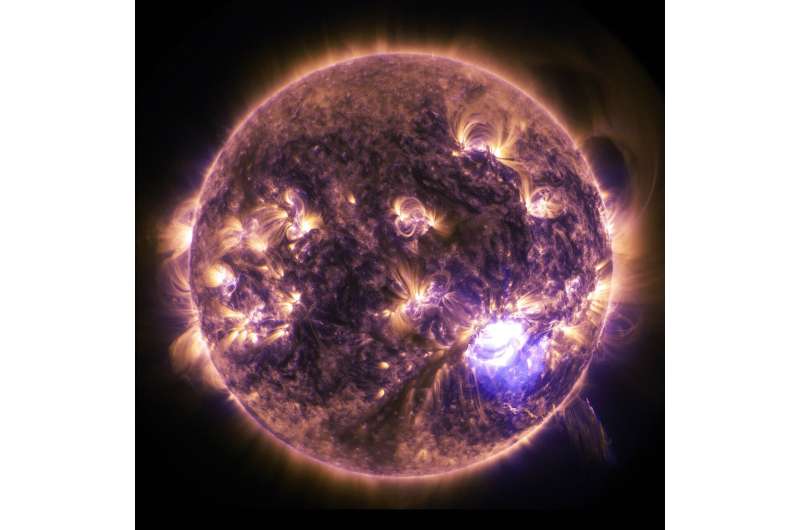
The regular solar cycle is a mere climate murmur, but sudden geomagnetic jolts are a different story. These high-altitude outbursts appear to be hijacking the polar vortex to rewrite weather on the ground.
For years, scientists assumed the sun's 11-year cycle only gives Earth a faint nudge. Even at solar maximum, sunlight varies by less than a tenth of a percent—changing global temperatures by mere hundredths of a degree. In other words, the regular solar cycle is a gentle tide in the climate system. But what about sudden solar outbursts?
A new study in Geophysical Research Letters finds that these fast, magnetic storms in Earth's upper atmosphere produce a much louder signal for the weather. Analysis of 67 years of data shows a single strong geomagnetic storm can unleash dramatic local weather changes—far beyond anything expected from the slow solar cycle. Bursts of solar magnetism, it turns out, can "slam into Earth's climate system like cannon fire."
A solar whisper vs. a sudden jolt
Even at peak activity, the sun's brightness barely changes, so climate models largely ignore it. Hypotheses like cosmic rays seeding clouds or solar UV jittering winds have been proposed, but none are confirmed. This makes the new findings startling.
Rather than a gentle murmur, solar outbursts appear to slam down on atmospheric circulation with surprising force, at least on a regional scale. This study shows that these short-lived storms—not the slow 11-year cycle—can abruptly jolt surface weather.
Digging into decades of data
To uncover these effects, researcher J. Raeder pored over 1950–2017 records. He paired the hourly Dst storm index (a standard measure of geomagnetic disturbances) with ERA5 reanalysis maps of North American weather. Every time Dst plunged, he recorded anomalies in surface temperature, air pressure, wind, precipitation and solar radiation. The data were sorted by storm strength and by season, producing statistical maps of the impact.

The result was a high-resolution portrait of a sun–weather connection. When big storms strike, distinctive anomalies "snap" into place. In winter, for example, a strong storm often coincides with a belt of unusually cold readings across parts of the U.S. (with warming to the south); in summer the pattern can reverse. These swings build and then fade over a few days. Crucially, the study suggests these storm-driven pulses can dwarf normal day-to-day variability.
Winter blasts and top-down coupling
The effects vary by season and region. The maps show the strongest weather jolts in winter. Why winter? A likely clue is the stratospheric polar vortex—a giant, high-altitude circulation that is strongest in cold months. A geomagnetic storm deposits energy in the upper atmosphere, altering the polar vortex, and that ripple appears to trickle downward. In effect, regions under the disturbed jet stream see sudden shifts in temperature, pressure and winds.
Notably, the usual suspects aren't responsible. The data "rule out energetic particle precipitation as a cause," the author notes. The study found that cosmic rays or high-energy particles raining into the atmosphere did not explain the weather swings. Instead, the evidence points to a magnetosphere–atmosphere link from above. As the study observes, the patterns "point to a top-down mechanism such as polar vortex coupling."
Looking ahead: Forecasts and models
This is just the first step. So far, the work covers only North America (where detailed data were available) and one statistical approach. It can't yet pinpoint the exact physics or say if every continent experiences the same drama. Future work will extend the analysis globally and test more storms.
In the meantime, the practical takeaway is clear: Space weather may matter to us in real time. Meteorologists could incorporate geomagnetic storm alerts into forecasts. For example, a severe storm warning might signal unusually strong cold fronts or wind shifts to come. Climate models may also need tweaking to include these top-down solar effects.
Sun storms might bring more than light shows. In Raeder's words, "Geomagnetic storms have profound effects on terrestrial weather, that is, temperature, pressure, wind, precipitation, and solar irradiation."
If this conclusion holds, then a burst of space weather could indeed leave its imprint on the ground—effectively turning a solar tantrum into a terrestrial weather shock.
