HIV's hidden history: New study reveals much deeper roots stretching back millions of years

Sadie Harley
Scientific Editor

Andrew Zinin
Chief Editor

Sayan Tribedi
Author
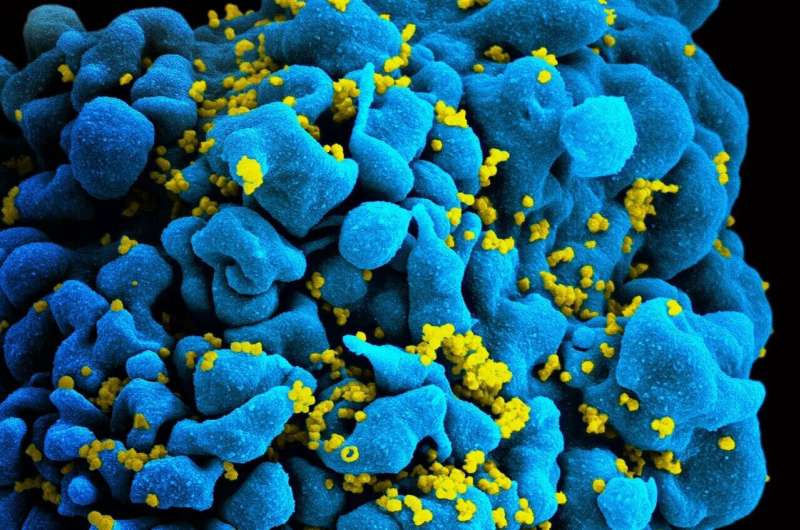
Researchers used to think that HIV and its relatives were pretty recent things, maybe only a few hundred years old. But a growing body of evidence now suggests their history is far more ancient, with viruses closely related to HIV circulating in primates for tens or hundreds of thousands of years, and the very roots of their family tree perhaps stretching back millions of years.
This deeper understanding comes from new research that re-examines the "molecular clock" used to date viruses. It reveals that this viral clock doesn't tick at a constant rate; instead, genetic changes accumulate rapidly over short periods but appear to slow significantly over millennia. Consequently, traditional genetic clocks can dramatically underestimate the true age of ancient viral lineages.
In a study, published in Proceedings of the Royal Society B: Biological Sciences, a time-dependent clock model, known as the "Prisoner of War" model, was used to analyze 436 sequences from HIV, SIV (simian immunodeficiency virus), and related viruses. This analysis indicates that the ancestors of HIV-1 and HIV-2 have been present in primates for at least tens to hundreds of millennia, a surprising departure from earlier assumptions about their age.

Fossil clues in primate DNA
Evidence of this timeline is the existence of viruses in the genome of some animals that we never would have imagined possible. Primates have fragments of what is known as lentivirus (HIV family) in their DNA, thus proving infection many millions of years ago. For example, lemurs in Madagascar possess the endogenous lentivirus insert that is approximately 4.2 million years old, which proves that primates had been fighting viruses similar to HIV long before our time. In Africa, however, one more piece of evidence can be found on Bioko Island.
The island split away from the mainland approximately 10,000 years ago, separating the monkey population there. It turned out that there are different strains of SIV, so different that the models of their separation show that the age of SIV must be at least 32,000–75,000 years (and probably even more).

These clues say one thing: across a million years, the virus's DNA drifted so little that short-term clocks miss the full story.
"Time-dependent rate" decay, where substitutions accumulate more slowly over longer times, seems to be at work. In practical terms, it means researchers must recalibrate their clocks.
The new model does just that, aligning viral genomes with a timeline that spans recent (HIV), intermediate (Bioko SIV) and ancient (lemur lentivirus) events. By doing so, the study reconciles genetic evidence with paleovirology and biogeography, producing consistent dates across these timescales.
A much older virus family
Applying this model yields some eye-opening data. The most recent common ancestor of all known African SIV strains dates back to about 1 million years ago (previously it was thought to be much younger). The chimpanzee SIV lineage that eventually spawned HIV-1 appears to have circulated for tens of thousands to a couple hundred thousand years in chimps.
The sooty mangabey SIV that gave rise to HIV-2 is younger (just thousands of years old), but still far older than simple models predicted. And then there's the deepest branch: the split between African SIVs and the lemur virus lineages is dated to 17–51 million years ago.
That astonishing gap suggests an ancient cross-species jump—perhaps a drifting mammal raft or mosquito carrying a lentivirus to Madagascar in the distant past—rather than a virus staying in one lineage throughout primate evolution.
These timelines are mind-bogglingly long compared to the 20th-century HIV pandemic. They imply that HIV-like viruses were present in primate populations through the Pleistocene and beyond. Why haven't humans seen epidemics until now?
The study notes that dramatic changes in human society—like population growth, travel and urbanization, probably provided the "spark" that allowed a previously benign SIV to jump and spread among people. It indicates that humans may have shared space with HIV's ancestors for eons without epidemic disease.
Why it matters
Knowing a virus's deep history can help us assess risk and understand immunity. Mapping these long timelines may reveal which traits let a virus jump species or spread efficiently among humans. It could also show why many primates tolerate SIV infections.
Unlike humans, most African monkeys infected with their own SIV strains never develop AIDS—a product of their long coevolution. Studying that natural resistance might inspire new treatments or vaccines for HIV. This new work is a kind of fossil hunt in the genetic code, reminding us that the viruses causing modern pandemics often have ancient lineages.
As the authors caution, however, these dates are best seen as model-based windows, not precise timestamps. In their words, "Our estimates should be interpreted as model-based timescale reconstructions under explicit assumptions." Still, by pushing the clock back, the study pulls us along a journey through deep time—a journey that may ultimately explain how a quiet primate virus became a global threat.
