Best of Last Week – New kind of carbon, best images yet of Pluto and a diabetic drug that favorably affects gut bacteria


New Horizons Returns First of the Best Images of Pluto
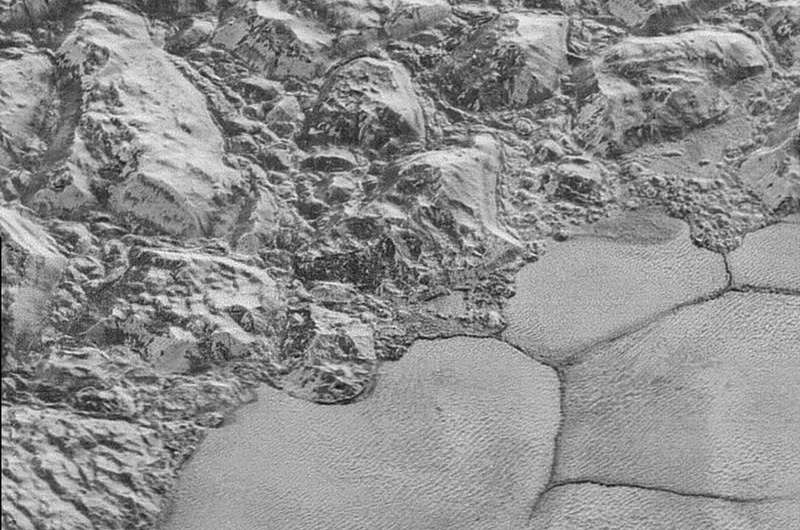
The Mountainous Shoreline of Sputnik Planum: In this highest-resolution image from NASA’s New Horizons spacecraft, great blocks of Pluto’s water-ice crust appear jammed together in the informally named al-Idrisi mountains. "The mountains bordering Sputnik Planum are absolutely stunning at this resolution," said New Horizons science team member John Spencer of the Southwest Research Institute. "The new details revealed here, particularly the crumpled ridges in the rubbly material surrounding several of the mountains, reinforce our earlier impression that the mountains are huge ice blocks that have been jostled and tumbled and somehow transported to their present locations." Credit: NASA/JHUAPL/SwRI

(ScienceX)—It was another good week for physics as one team of researchers at North Carolina State University found a new phase of carbon and made diamond at room temperature—it is called Q-carbon and is distinct from any known phase of regular diamond or graphite. Another team of international researchers announced that they were able to confirm thermodynamic irreversibility in a quantum system—despite quantum theories based on time-symmetry. And a team working with the U.S. Department of Energy's Holometer ruled out a theory of space-time correlations—they used the super-sensitive device to rule out Hogan's theory of a pixelated universe to a high level of statistical significance.

It was also a pretty big week for space science as one team of astronomers studying data from the Green Bank Telescope found a detailed record of a mysterious fast radio burst—which revealed that the burst came from a highly magnetized particular region of space. Also, NASA's space probe New Horizons returned the first of the best images yet of Pluto—and they were quite impressive. There were also reports of new developments in the study of black holes; researchers working with the Event Horizon Telescope detected magnetic fields at Milky Way's central black hole, and another team of astrophysicists found evidence that the jet of a black hole was driving multiple winds in a nearby galaxy—specifically, galaxy IC5063; the distances were as great as 3000 light years.

In other news, there was a report that Chinese 'clone factory' scientists are eyeing human replication—Boyalife Group chief executive Xu Xiaochun hinted to the press that the group might be considering such a move as he outlined a sequence of research projects the team is working toward, moving from cloning racehorses to dogs and eventually to non-human primates, which would, of course, make the jump to human cloning a looming possibility. Another team of researchers at North Carolina State University announced that they had confirmed original blood vessels in an 80 million-year-old fossil. The results offer more evidence that and other such soft structures can persist over millions of years.

And finally, if you are one of the millions of diabetic people taking metformin to help manage the disease, you might want to look into the results of a study by a team of Chinese and European researchers—they found that intestinal bacteria are affected by the antidiabetic drug—and the changes are favorable.

© 2015 ScienceX

Citation: Best of Last Week – New kind of carbon, best images yet of Pluto and a diabetic drug that favorably affects gut bacteria (2015, December 7) retrieved 4 May 2026 from https://sciencex.com/news/2015-12-week-kind-carbon-images-pluto.html
This document is subject to copyright. Apart from any fair dealing for the purpose of private study or research, no part may be reproduced without the written permission. The content is provided for information purposes only.

Written for you by our author Bob Yirka—this article is the result of careful human work. We rely on readers like you to keep independent science journalism alive. If this reporting matters to you, please consider a donation (especially monthly).

Latest stories

Glowing nanoparticles exposed hidden cancer-protein behavior that could reshape drug screening

Using a powerful single-molecule imaging method they developed, a Broad Institute research team has unveiled a dynamic view of how some cancer-related proteins interact in living cells. The technique relies on highly stable ...

One missing metabolic step can turn cancer's DNA-copying machinery into a lethal weakness

Loss of an enzyme necessary for a process called lipoylation disrupts the way cancer cells copy their DNA, increasing their vulnerability to a class of anticancer drugs known as PARP inhibitors, a study led by UT Southwestern ...

Cranberry juice may boost UTI antibiotics

More than 400 million people experience a urinary tract infection every year, and some epidemiological studies estimate that more than half of all women will develop at least one in their lifetime. Most UTIs are caused by ...

Chromatin tracking reveals two motion modes that help control gene expression

Gene expression is controlled, in part, by the interactions between genes and regulatory elements located along the genome. Those interactions depend on the ability of chromatin—a mix of DNA and proteins—to move around within ...

Who are his people? The 4,000-year hunt for a warrior's kin

For 4,200 years, the Y chromosome of a Yakutian warrior has quietly echoed in Siberia's Arctic peoples. His extraordinary Stone Age grave was discovered in Russia's far northeast near Yakutsk in 2004 by scientists. The middle-aged ...

Live camel transportation improved by using food as an incentive in place of physical punishment

Around the world, millions of camels are farmed for milk and meat while others are used in leisure activities like racing and riding. Yet the treatment of these animals as livestock can be harsh, especially during transport. ...

Speed 'training' prepares bacteria for complex tasks, like munching plastics

Millions of tons of plastic waste accumulate in landfills and oceans every year. One promising response is to engineer microbes to break the plastic down into useful chemical building blocks. However, teaching a bacterium ...

X-linked liver enzyme may explain why women and men process cholesterol differently

A new study from Karolinska Institutet shows that an enzyme in the liver may partly explain sex differences in the body's handling of cholesterol and the risk of developing atherosclerosis. The research, published in Nature ...

Babies may share adults' sense of beauty, and it appears to sharpen with age

Humans tend to be captured by things around them that they perceive as pleasurable and aesthetically pleasing. This "sense of beauty" has been widely studied extensively, mostly in experiments that involved adult participants.

Nocturnal migratory birds follow rhythm of the moon, study shows

Moonlight determines when the red-necked nightjar feeds, migrates and raises its young. A groundbreaking long-term study from Lund University shows how the migratory bird's entire annual cycle follows the moon's rhythm.