Best of Last Week–Using quantum physics to factor numbers, the Earth's technosphere and brain activation by spiritualism

Earth’s ‘technosphere’ now weighs 30 trillion tons, research finds
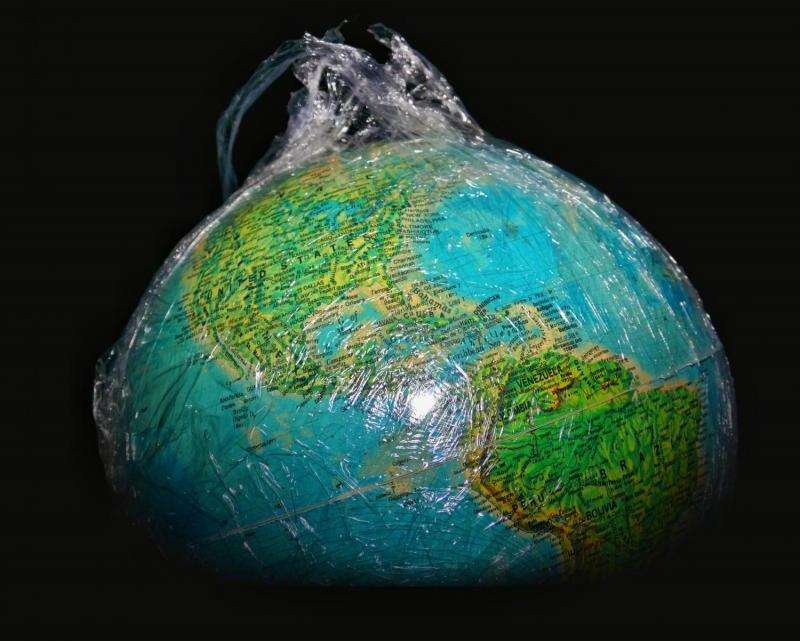
Earth and cling film. Credit: University of Leicester

(ScienceX)—It was a good week for physics as a team at the University of California reported that they made a discovery combining quantum physics and photosynthesis that could lead to highly efficient solar cells. A team at MIT announced that they had discovered an astonishing behavior of water confined in carbon nanotubes—its freezing point changed dramatically. And a team at the Technical University of Madrid found that quantum physics offered a new way to factor numbers by mimicking the math rather than doing actual calculations. Also, a team of European researchers working with the ESO's Very Large Telescope found what they believe may be the first signs of a weird quantum property of empty space—vacuum birefringence.

In planetary news, a team of geologists with the University of Cincinnati reported that they had uncovered 2.5 billion-year-old fossils of bacteria that predate the formation of oxygen from a site in a Northern Cape Province of South Africa. Also, a team with Ohio State University offered evidence of the West Antarctic ice shelf breaking up from the inside out, which, they suggest, indicates that the ocean is causing ice at the edge of continents to become weaker. And an international team of researchers found that the Earth's 'technosphere' now weighs 30 trillion tons—it includes every single human-made thing on the planet.

In other news, a team of biologists in the U.S. reported that they observed speciation in a laboratory flask—the evolution of a new virus species occurred so quickly the found they could observe it in action. A team working at Johns Hopkins made headlines with their discovery that the hallucinogenic drug psilocybin eases existential anxiety in people with life-threatening cancer—the active ingredient in mushrooms, they found, could help people better cope with very stressful situations.

And finally, if you are the religious sort, it might interest you to know that a team of researchers with the University of Utah School of Medicine found that spiritual experiences activate brain reward circuits—similar, they claimed, to the way the brain behaves when people are falling in love, having sex, engaging in gambling or drugs or listening to music.

© 2016 ScienceX

Citation: Best of Last Week–Using quantum physics to factor numbers, the Earth's technosphere and brain activation by spiritualism (2016, December 5) retrieved 24 April 2026 from https://sciencex.com/news/2016-12-weekusing-quantum-physics-factor-earth.html
This document is subject to copyright. Apart from any fair dealing for the purpose of private study or research, no part may be reproduced without the written permission. The content is provided for information purposes only.

Written for you by our author Bob Yirka—this article is the result of careful human work. We rely on readers like you to keep independent science journalism alive. If this reporting matters to you, please consider a donation (especially monthly).

Latest stories

A third of animal habitats on land could experience multiple extreme events by 2085, new study suggests

By 2085, 36% of species' current habitats on land could be exposed to multiple types of climate-driven extreme events such as heat waves, fire or floods if warming continues to rise into the latter half of the century. The ...

OpenAI launches GPT-5.5 as rivals race to build more autonomous AI assistants

OpenAI released a new model it touts as its best yet for handling research work like making improved versions of itself, as rapid-fire releases by AI rivals pick up pace.

This 2,200-year-old Roman wreck hid a repair story that rewrites how ancient ships survived long voyages

Ever since humans have embarked on sea voyages, they needed to ensure vessels were waterproof, resistant to salty seawater, and could withstand microorganisms or sea-dwellers like worms. Until the mid-20th century, however, ...

New bioreactor turns stem cells into an immune-cell factory, producing 40 million human macrophages per week

Researchers at Hannover Medical School (MHH) have developed a method for the efficient production of human immune cells, such as macrophages, in medium-sized bioreactors. These immune cells can be derived from induced pluripotent ...

AI squeezes individual breast cells to learn how to spot cancer risk

Researchers at City of Hope, a cancer research and treatment organization, and the University of California, Berkeley, have created a novel microfluidic platform that can assess women's breast cancer risk at the cellular ...

DNA damage just got more complicated: A long-missed weak spot emerges when light and oxygen strike

In everyday life, our genetic material is constantly under attack from many factors. Environmental influences such as light, along with internal processes like inflammation, can generate oxidative stress that damages DNA ...

Hidden mosquito viruses emerge as RNA immune signals map global infections

Aedes aegypti, commonly known as the yellow fever mosquito, is a highly adapted, invasive mosquito species recognized as a major global health threat that acts as the primary vector for several severe diseases, most notably ...

Milky Way's 'little cousins' may hold clues about infant universe

Ultra-faint dwarf galaxies—tiny satellite galaxies orbiting the Milky Way—have long been seen as cosmic fossils. Now, a new study published today in Monthly Notices of the Royal Astronomical Society uses an unprecedented ...

Moon dust could stop being a nuisance and start reshaping how humans may build beyond Earth

As space agencies and private companies look toward a sustained human presence on the moon, a fundamental challenge centers on how to build strong, durable infrastructure without hauling every material from Earth. New research ...

These 'good' viruses hold up a booming industry—AI just found a faster way to track them

Researchers have developed a new methodology that uses artificial intelligence tools to identify and count target viruses more efficiently than previous techniques. The new approach can be used in applications such as pharmaceutical ...