Best of Last Week—A new way to see matter, brain changes when wearing police uniform and baby gender impact on mother


Wave of the future: Terahertz chips a new way of seeing through matter
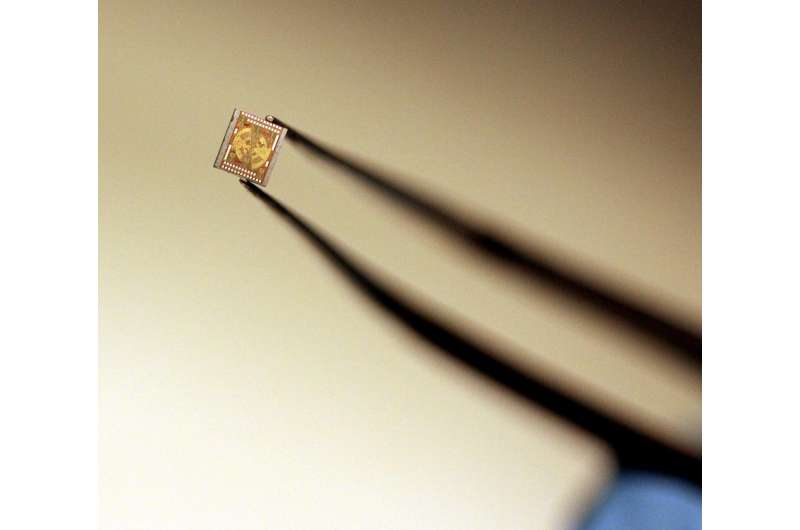
Princeton University researchers have drastically shrunk the equipment for producing terahertz -- important electromagnetic pulses lasting one millionth of a millionth of a second -- from a tabletop setup with lasers and mirrors to a pair of microchips small enough to fit on a fingertip (above). The simpler, cheaper generation of terahertz has potential for advances in medical imaging, communications and drug development. Credit: Frank Wojciechowski for the Office of Engineering Communications

(ScienceX)—It was a good week for technological advancements as a team of researchers with the University of Oulu in Finland announced that they had developed a material that can turn sunlight, heat and movement into electricity—all at once. It is based on a mineral with a perovskite crystal structure. Also, a team with the Harvard John A. Paulson School of Engineering and Applied Sciences announced that they had developed a long-lasting flow battery that could run for more than a decade with minimum upkeep—the technology involves storing energy in organic molecules dissolved in neutral pH water. And a team at Princeton University announced that they developed terahertz chips that offer a new way of seeing through matter—using electromagnetic pulses that last just a millionth of a second.

It was a good week for space research as well, as a team at the University of Cambridge announced that they had found a bridge of stars that connects two dwarf galaxies—the two largest in the Milky Way, the Magellanic Clouds. The bridge spans approximately 43,000 light years. And Curiosity rover sharpened the paradox of ancient Mars by sending back data showing that the planet had too little carbon dioxide 3.5 billion years ago to allow for a greenhouse effect that could have allowed water to exist on the surface.

In other news, a combined team from the University of Wyoming, the University of Bern and the Swiss Federal Institute of Aquatic Science and Technology found evidence that appears to solve a fish evolution mystery in Lake Victoria in East Africa—hybridization between two distantly related cichlid species from the Upper Nile and Congo drainage systems. Also, a team at McMaster University found that wearing a police uniform changes the way the brain processes info and can impact how that person perceives others. Also, a combined team from Hebrew University of Jerusalem's Institute of Archaeology and Liberty University in Virginia announced that they had found the 12th Dead Sea Scrolls cave near the Dead Sea. And a team of researchers in the U.K. found that LED lighting could have a major impact on wildlife because some organisms can be drawn to it.

And finally, if you are a woman and are either planning on getting pregnant or already are, you might want to take a look at a report by a team at Ohio State University's Wexner Medical Center—they found that a baby's sex plays a role in pregnant women's immunity—female fetuses produced more pro-inflammatory cytokines when exposed to bacteria in suggesting that carrying a girl may offer more immunity against infections.

© 2017 ScienceX

Citation: Best of Last Week—A new way to see matter, brain changes when wearing police uniform and baby gender impact on mother (2017, February 13) retrieved 24 April 2026 from https://sciencex.com/news/2017-02-weeka-brain-police-uniform-baby.html
This document is subject to copyright. Apart from any fair dealing for the purpose of private study or research, no part may be reproduced without the written permission. The content is provided for information purposes only.

Written for you by our author Bob Yirka—this article is the result of careful human work. We rely on readers like you to keep independent science journalism alive. If this reporting matters to you, please consider a donation (especially monthly).

Latest stories

Carbon nanotubes are closing the gap on copper conductivity

Carbon nanotubes are one technology that many observers believe hasn't quite lived up to the extreme hype that surrounded them when they first appeared on the scene in the late 1990s. At that time, much was made of their ...

Genetic study reveals likely cause of common heart valve defect

New clues from genetic research may help explain what causes the most common heart defect present at birth. Researchers at KTH Royal Institute of Technology and Karolinska Institutet have identified rare DNA changes during ...

Scientists map hidden magnetism on the sun's far side

For observers on Earth, the sun appears as a bright, familiar disk—but what we see is only half the story. Like the moon, one half of the sun is permanently hidden from our direct view: the far side beyond the visible solar ...

Animal-linked influenza D multiplies efficiently in human respiratory tissue, hinting at spillover

The influenza D virus that researchers say has been flying under the radar since its detection in animals in 2011 can vigorously make copies of itself in human cells and lung tissue samples, a new study shows. The findings ...

Why delaying climate action now means higher seas by 2100

Imagine your favorite sunny beach. Anywhere will do. You look out and see the ocean stretching to the horizon. To a glaciologist, that view is not just water; it's melted ice. Our new study shows that the best case sea-level ...

Sombrero Galaxy's vast halo emerges in rare detail 30 million light-years away

Messier 104, nicknamed the Sombrero Galaxy, is a popular target for amateur observing and astronomical research. Its recognizable extended halo, as well as a faint stellar stream, are captured in exquisite detail in this ...

'Aquila Booster' challenges theoretical limits of particle acceleration in pulsar wind nebulae

The Large High Altitude Air Shower Observatory (LHAASO) has detected PeV (1015 eV) gamma-ray emission from a pulsar wind nebula powered by PSR J1849-0001 in the constellation Aquila, marking the discovery of a new PeVatron ...

LAMOST maps open cluster NGC 1647, linking broad main sequence to differential reddening

Using the Large Sky Area Multi-Object Fiber Spectroscopic Telescope (LAMOST), astronomers have observed a nearby young open cluster known as NGC 1647. Results of the new observations, presented in a paper published April ...

Exploiting a new vulnerability that targets 'zombie' cells as an anticancer therapy

A new set of drugs exploit a recently revealed weakness in "zombie-like"—or senescent—cells that could lead to new treatments for cancer and age-associated diseases. The study from the MRC Laboratory of Medical Sciences (LMS) ...

Gravity's subtle effect on light could improve groundwater, volcano and carbon storage monitoring

A study by University of Wollongong (UOW) physicist Dr. Enbang Li has demonstrated that gravity can subtly influence the behavior of light, a breakthrough that could underpin future technologies for monitoring groundwater, ...