Best of Last Week–Wi-Fi on rays of light, running away from Einstein and a breakthrough in identifying heart attack risk


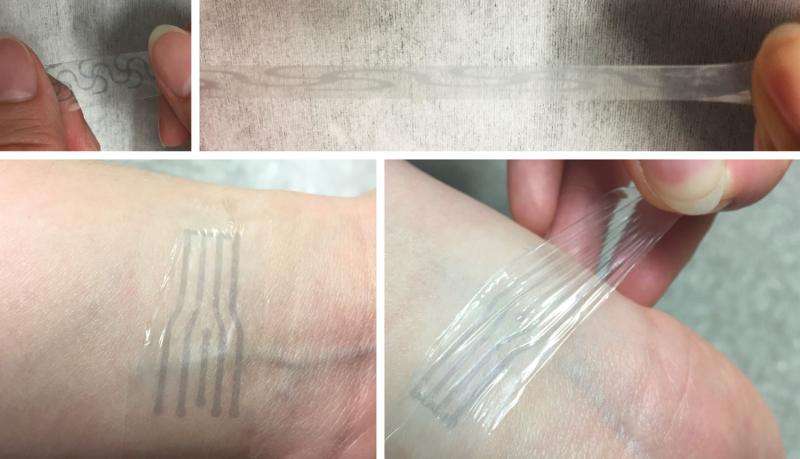
Engineers develop a plastic electrode that stretches like rubber but carries electricity like wires
A printed electrode pattern of the new polymer being stretched to several times of its original length (top), and a transparent, highly stretchy “electronic skin” patch forming an intimate interface with the human skin to potentially measure various biomarkers (bottom). Credit: Bao Lab

(ScienceX)—It was a good week for technology as a team with Eindhoven University of Technology announced that they had come up with Wi-Fi on rays of light—a wireless network based on infrared rays that is 100 times faster than current systems and never overloads. Also, a team at Stanford University reported that they developed a plastic electrode that stretches like rubber but carries electricity like wires—it is also compatible with human nerves. And a team with a European superconductivity research project called Eurotapes announced a superconductivity breakthrough—a superconducting tape 600 meters long that is able to conduct 100 times more electricity than copper.

In news from space, an international team of researchers using a telescope in northern Chile reported that they observed a dying red giant star's final act. And another international team of astronomers reported on a mysterious isolated object they investigated—they believe it is it either an isolated planet-like object or a low-mass brown dwarf. A team at the University of St. Andrews reported on their study of a ring of galaxies that appear to be moving away from us faster than predicted, which they describe as "running away from Einstein."

Also, two news stories made the headlines this week. In the first, a combined team from the University of Basel and Lund University announced that they had found that spiders eat 400-800 million tons of prey every year making them one the world's most species-rich and widespread groups of predators. In the other story, archaeologist David Wright with Seoul National University publicly wondered, whether humans created the Sahara Desert. He thinks we might have. In an unrelated story, a team at Oregon State University found that a dietary anti-cancer compound may work by influencing cellular genetics—and it is found in broccoli.

And finally, if you are one of the billions across the planet trying to avoid having a heart attack, you might be interested in a new study that found a potential breakthrough in determining who's at risk for heart attacks—a team at Intermountain Medical Center Heart Institute found that hard plaque in arteries may be more deadly than soft plaque after all.

© 2017 ScienceX

Citation: Best of Last Week–Wi-Fi on rays of light, running away from Einstein and a breakthrough in identifying heart attack risk (2017, March 20) retrieved 2 May 2026 from https://sciencex.com/news/2017-03-weekwi-fi-rays-einstein-breakthrough-heart.html
This document is subject to copyright. Apart from any fair dealing for the purpose of private study or research, no part may be reproduced without the written permission. The content is provided for information purposes only.

Written for you by our author Bob Yirka—this article is the result of careful human work. We rely on readers like you to keep independent science journalism alive. If this reporting matters to you, please consider a donation (especially monthly).

Latest stories

Blood vessels activate self-defense response that may slow atherosclerosis progression

A study by researchers at Baylor College of Medicine and collaborating institutions reveals a previously unrecognized way blood vessels can protect themselves from damage and slow the development of atherosclerosis. The findings, ...

Locked in stone for 210 million years, this newly identified crocodile cousin was built to crush larger prey

On a fateful day 210 million years ago, two crocodile cousins about the size of jackals stood side-by-side amid the low ferns of a humid riverbank that would one day become northern New Mexico. One of the crocs, Hesperosuchus ...

Lithium not working? Large-scale study highlights favorable treatment strategies for bipolar disorder

Bipolar disorder is a mental health condition estimated to affect between 1% and 3% of people worldwide. Its main symptoms include extreme mood swings, ranging from periods of high activity and emotional high (i.e., mania) ...

That split-second panic when something rushes toward you may hinge on one deceptively simple sound cue

Those jolts of terror that seem to occur whenever a noise comes closer? While we assume that this is an age-old survival reaction, modern revelations show that there may be an easier explanation for what's occurring.

Coffee doesn't just wake you up—a key biological pathway illuminates widespread health effects

For decades, research has linked coffee consumption to longer life and lower risk of chronic disease—but exactly how those benefits occur has remained unclear. Now, new research from the Texas A&M College of Veterinary Medicine ...

Hidden plant molecules show up to 25 times stronger activity against Ebola and COVID-19

Scientists at the Université de Montréal's affiliated Montreal Clinical Research Institute (IRCM) have identified a new family of natural molecules with strong antiviral activity, notably against the Ebola virus and SARS-CoV-2, ...

Flooded fields across Midwest spur push for farm-tested solutions

Larry Dallas's farm in Central Illinois's Douglas County is as flat as it gets. That's a good thing for planting straight rows and maneuvering farm equipment in the field, but there's a major downside, too. "Heavier rain ...

Saturday Citations: In spaaa-aaace!

We're focusing on space news this week, but we did cover the usual amount of local news down here in Earth's gravity well: A new Tokamak reactor regime sustained stable plasma fusion for one full minute. An anomaly in global ...

Bees can detect viruses in food sources, but don't necessarily avoid them

The ability to detect viruses and other harmful pathogens is highly advantageous for animals, as it can guide their behavior and prevent them from illness, and—in severe cases—death. When it comes to species that live in ...

A brownie, a drink, a drive: Hidden impairment standard sobriety tests completely miss

Johns Hopkins Medicine researchers have added to evidence that using cannabis edibles and alcohol together worsens driving impairment compared with consuming either substance alone. The study also found that cannabis (alone ...