Best of Last Week – Caterpillars eating plastic, math describings time travel and testosterone's impact on male behavior

Caterpillar found to eat shopping bags, suggesting biodegradable solution to plastic pollution
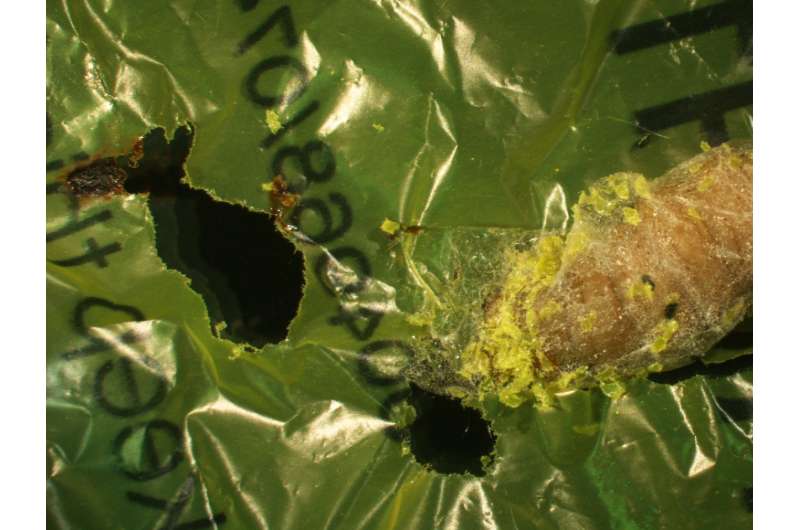
A close-up of wax worm next to biodegraded holes in a polyethylene plastic shopping bag from a UK supermarket as used in the experiment. Credit: Paolo Bombelli

(ScienceX)—It was an interesting week for earth sciences as a team from Spain and the U.K. reported on a caterpillar that was found to eat shopping bags, suggesting a biodegradable solution to plastic pollution—the wax worm, larva of the greater wax moth was found by accident to be a possible means for reducing landfill waste. Also, a professor at the University of Central Florida invented a way to trigger artificial photosynthesis to clean air—he reduced two forms of carbon dioxide to formate and formamides.

In other news, data from NASA's Cassini mission suggested a new picture of the sun's interaction with the galaxy, calling into question an alternate view of the trailing behind the sun. The new data was used in combination with older data from the Voyager mission. Also, a mathematician at the University of British Columbia used math to investigate the possibility of time travel—Ben Tippett came up with a formula that described a way to achieve time travel. Also, a team of researchers in the U.S. announced that they had designed 2-D materials that conduct electricity at almost the speed of light for possible use in quantum computers. And a team with the University of Melbourne released world-first images of electric currents in graphene, offering a new way to learn how currents flow in the material. And a team from the U.S. and Australia found evidence of humans in America 115,000 years earlier than thought—prior to the discovery, the earliest evidence of humans was just 15,000 years ago.

Also, a team from Portugal and Australia found that gut bacteria tell the brain what animals should eat, though how they do so is still a mystery. In somewhat related news, a team at the University of Connecticut found that active ingredients in both hot peppers and cannabis calm the gut's immune system, further suggesting a possible link between the gut, the brain and other systems.

And finally, if you are male, or have wondered about the sometimes erratic behavior of males in your life, you may be interested in a study conducted by a team with members from Caltech, the Wharton School, Western University, and ZRT Laboratory—they found that testosterone makes men less likely to question their impulses, which might explain some hotheaded behaviors.

© 2017 ScienceX

Citation: Best of Last Week – Caterpillars eating plastic, math describings time travel and testosterone's impact on male behavior (2017, May 1) retrieved 24 April 2026 from https://sciencex.com/news/2017-05-week-caterpillars-plastic-math-testosterone.html
This document is subject to copyright. Apart from any fair dealing for the purpose of private study or research, no part may be reproduced without the written permission. The content is provided for information purposes only.

Written for you by our author Bob Yirka—this article is the result of careful human work. We rely on readers like you to keep independent science journalism alive. If this reporting matters to you, please consider a donation (especially monthly).

Latest stories

Amazon recovery masks diversity loss as fires, droughts and windstorms reshape forest edges

Even after fires, severe droughts, and windstorms, the vegetation in degraded Amazonian forests demonstrates a high capacity for regeneration, including tree species. However, recovery occurs under new ecological conditions, ...

First gap-free peanut genomes reveal genes behind bigger seeds and better oils

An international team of researchers has produced complete, gap-free genome sequences for six peanut varieties, providing a comprehensive blueprint for future peanut breeding and improvement strategies.

New approach to detect ultra-rare part-per-sextillion isotopes could also sharpen dark matter searches

The detection and study of isotopes, atoms of the same element that have different numbers of neutrons, could expand the scope of physics research and enable new scientific discoveries. So far, rare isotopes have been primarily ...

Why faster AI isn't always better

In the race to make AI models not just reason better but respond faster, latency—the delay before an answer appears—is often treated as a purely technical constraint, something to minimize and move past. But how is this relentless ...

US dentists still prescribe far more opioids for pain than peer nations

People getting their teeth pulled or drilled by dentists in the United States are still much more likely to get powerful opioid medications than dental patients in other developed countries or even the U.S. territory of Puerto ...

Mechanical forces from the beating heart may help prevent cancer cell growth

Scientists may have discovered another way the human body tries to protect itself from cancer. New research on mice suggests that the heart's constant beating may prevent tumor growth in cardiac tissue. Most organs are vulnerable ...

Beavers leave a trail as they head into the Arctic and reshape the landscape

A study has provided new evidence of beavers' expansion into the Canadian Arctic by dating the changes they have made to the tundra landscape as they spread northward. Published in the journal Ecosphere, the research combines ...

One blue whale song unlocks oceans of data

Trying to find a whale song in the ocean is like trying to find a needle in a haystack. But now, UNSW Sydney researchers say they've trained a model, with just a single case study, to find blue whale songs in recordings that ...

Orbital dances unlock true masses of Orion's young stars

A star's mass determines its entire life story, from how it shines to how it dies. For young stars shrouded in dust, getting an accurate mass has long been difficult, but new radio measurements are beginning to change that. ...

Why solar research should stop leading with climate

Kodak invented the digital camera in 1975. Management looked at it, decided film was doing fine, and put the technology in a drawer. By the time they took it seriously, other companies had taken the market. Kodak filed for ...