Best of Last Week – Biggest dinosaur ever, rewriting human evolution and brain damage caused by playing video games


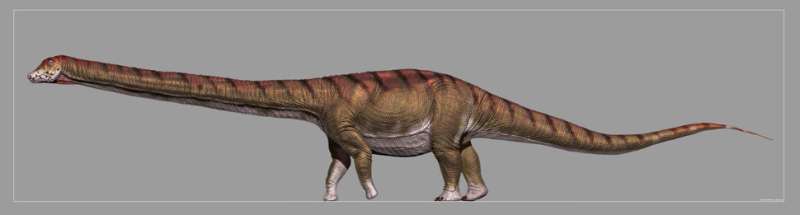
Patagotitan mayorum: New study describes the biggest dinosaur ever
Reconstruction of Patagotitan mayorum. Credit: Jorge Gonzalez

It was a big week for biological history as a team with members from several institutions in Argentina and one in the U.S. reported on their new study that investigated the biggest dinosaur ever: Patagotitan mayorum. When alive, the creature would have stood six meters at the shoulder, measured 37 meters long, and weighed approximately 69 metric tons. Also, a team at the University of Utah came up with a new way to analyze DNA sequences to learn more about early human populations; in the process, they found themselves rewriting the human evolution story. And a combined team of researchers from the University of Chicago and Beijing Museum of Natural History reported that they had discovered the first winged mammals from the Jurassic period in China. Also, an international team found that the modern domestic dog has a single geographic origin in what is now modern Germany, and that it got its start approximately 15,000 years ago.

It was also a big week for technology as an international team of researchers announced that they achieved the first data transmission through a terahertz multiplexer, possibly paving the way for the next generation of ultra-high bandwidth networks. Also, a small team with members from the U.S. and China demonstrated graphene electronic tattoos that can be applied to the skin with water. They are similar to traditional temporary tattoos, but can function as wearable electronic devices. And Elon Musk announced that the maiden Falcon Heavy rocket is to launch in November, while also acknowledging the high risk involved. The rocket will have a main center engine and two side boosters, all three of which have been designed to return to predesignated spots, allowing for reuse.

In other news, a team of Japanese scientists created ice cream that doesn't melt by adding an extract found in strawberries. And a team at Ohio State University announced a breakthrough device that heals organs with a single touch by generating any cell type of interest for treatment within the patient's own body.

And finally, if you like to play action-based video games, you might be interested in a study conducted by a team led by Greg West of the University of Montreal. They found that playing action video games can actually harm your brain—dong so regularly, they discovered, can lead to less grey matter in the hippocampus.

© 2017 Science X

Citation: Best of Last Week – Biggest dinosaur ever, rewriting human evolution and brain damage caused by playing video games (2017, August 14) retrieved 3 May 2026 from https://sciencex.com/news/2017-08-week-biggest-dinosaur-rewriting-human.html
This document is subject to copyright. Apart from any fair dealing for the purpose of private study or research, no part may be reproduced without the written permission. The content is provided for information purposes only.

Written for you by our author Bob Yirka—this article is the result of careful human work. We rely on readers like you to keep independent science journalism alive. If this reporting matters to you, please consider a donation (especially monthly).

Latest stories

Deadly droughts and floods wipe out young California salmon en route to Pacific

Salmon are becoming river "ghosts" as brutal droughts and violent floods cause unprecedented losses on their treacherous journey to the Pacific Ocean, scientists say. A study led by the University of Essex; NOAA Fisheries; ...

Rising temperatures could be driving up antibiotic resistance in soil, 11-year study finds

Every year, millions suffer, and thousands lose their lives to infections that were once easily treatable with the right dose of medication. The drugs are the same; human physiology is the same; the only difference is that ...

Family data reveal two genetic paths to childhood depression and anxiety

Many common mental health disorders, including depression and anxiety, are associated with a tendency to internalize problems or, in other words, to direct feelings inwards instead of expressing them and sharing them with ...

How camels 'beat the heat' at the cellular level

Living organisms must constantly adjust to their environment to survive. One of the most fundamental challenges is temperature. Even small shifts in heat or cold can disrupt the delicate balance inside cells, affecting how ...

How a newly discovered organelle could help reduce cow methane emissions

When cows burp, they send a substantial amount of methane gas into the air, which makes them a leading contributor to greenhouse gas emissions. According to research published in the journal Science, a newly discovered hydrogen-producing ...

New imaging method maps reversed DNA replication forks in single cells

Researchers at The University of Texas MD Anderson Cancer Center have developed a new imaging method, known as RF-SIRF, that quantitatively detects and maps reversed DNA replication forks with single-cell resolution. The ...

Atlantic bluefin's comeback reveals an ocean-spanning mix that could upend how this iconic fish is managed

Atlantic bluefin tuna, the largest of all tuna species, declined precipitously toward commercial collapse in the early 2000s after decades of overfishing. The species has since rebounded across most of its range, a recovery ...

This 'living plastic' activates and self-destructs on command

Many plastic products are designed to be used only once, yet the material itself lasts for years. But a new strategy is addressing this problem by creating products that self-destruct on command, known as living plastics. ...

Blocking a cellular inflammation process could result in effective therapy for pancreatic cancer

Scientists at The Wistar Institute and clinical researchers from ChristianaCare's Helen F. Graham Cancer Center & Research Institute have discovered a vulnerability in pancreatic cancer that could be targeted as a potential ...

A bright moon may dim the Eta Aquarid meteor shower made up of Halley's comet debris

The Eta Aquarid meteor shower soon will light the sky with debris from Halley's comet. But a bright moon will spoil the fun this year, making the display harder to glimpse.