Best of Last Week – Aliens may look like us, risk of quantum attacks on Bitcoin and the benefits of strength exercise


Aliens may be more like us than we think
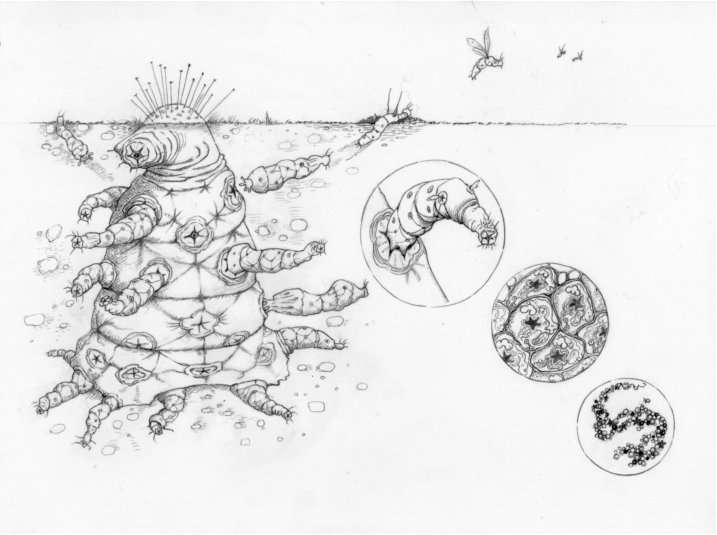
Major transitions in space: 'The Octomite'. A complex alien that comprises a hierarchy of entities, where each lower level collection of entities has aligned evolutionary interests such that conflict is effectively eliminated. These entities engage in division of labour, with various parts specialising on various tasks, such that the parts are mutually dependent. Credit: University of Oxford

(ScienceX)—It was a good week for space research as a team at NASA's Jet Propulsion Laboratory report that a Martian ridge brought out the Curiostiy rover's color talents—special filters on the rover helped identify mineral deposits, offering information key to determining where the rover should move to next. Also, a team at the University of Oxford applied evolutionary theory to organisms that might exist on other planets. In so doing, they found that aliens may be more like us than we think. In somewhat related news, a trio of physicists used data from the groundbreaking gravitational wave experiments and report rapid progress in bounding the speed of gravity—Einstein predicted a century ago that gravity propagates in waves at the speed of light, and the new experiments are bringing closer the possibility of proving it.

In technology news, researchers at Duke and Stanford universities described how a $10 microchip could turn 2-D ultrasound machines to 3-D imaging devices. And researchers with MIT, Adobe Research and the French Alternative Energies and Atomic Energy Commission unveiled a system for performing 'tensor algebra' that offers a 100-fold speed increase over previous software packages when dealing with sparse data applications. Also, an international team of researchers collaborating with Hyperchain released a white paper that outlines the risks that quantum attacks may pose for Bitcoin and other cryptocurrencies.

In other news, a team at the University of Arizona made headlines by announcing that it's mathematically impossible to beat aging, suggesting that work to prevent the process is moot. Also making headlines, an international team of researchers announced that they had discovered a hidden compartment in Egypt's Great Pyramid—the first new finding in the pyramid in hundreds of years. And a team at the University of Connecticut found evidence suggesting that bacterial fats, not dietary ones, may deserve the blame for heart disease—which helps explain why many people on lean diets still have heart attacks.

And finally, if you are someone trying to stay healthy by exercising, you might want to take note of a study done by a team at the University of Sydney, they found that strength exercise is as vital as aerobic activities, which means doing sit-ups or pull-ups in addition to running.

© 2017 ScienceX

Citation: Best of Last Week – Aliens may look like us, risk of quantum attacks on Bitcoin and the benefits of strength exercise (2017, November 6) retrieved 25 April 2026 from https://sciencex.com/news/2017-11-week-aliens-quantum-bitcoin-benefits.html
This document is subject to copyright. Apart from any fair dealing for the purpose of private study or research, no part may be reproduced without the written permission. The content is provided for information purposes only.

Written for you by our author Bob Yirka—this article is the result of careful human work. We rely on readers like you to keep independent science journalism alive. If this reporting matters to you, please consider a donation (especially monthly).

Latest stories

Microfluidic device tracks cell 'squishiness' faster and more reliably than standard methods

Researchers from Brown University and their collaborators have developed a new way to measure the properties of cells—an important development, they say, because accurate measurements of changes in cell elasticity can be ...

Fluorescent probe lights up centrioles and cilia in living cells across species

Scientists at EPFL have developed CenSpark, a fluorescent probe that makes centrioles and cilia visible inside living cells, helping researchers study cell division, development, and immunity like never before.

Scientists transform wool into bone repair material

Scientists have shown how wool could offer an effective and sustainable alternative to materials currently used to repair damaged bone. In the new study, keratin—a natural structural protein derived from wool—was shown to ...

When the rain comes, some NYC subway riders stay home. Scientists are now mapping exactly who, and where

On a sweltering August afternoon or in the teeth of a winter storm, New York City subway riders make a quiet calculation: Is the trip worth it? A new study published in npj Sustainable Mobility and Transport takes a detailed ...

Depression treatment is shifting, and this mushroom-derived compound is driving one of psychiatry's biggest new tests

Depression is a debilitating mental health disorder that is estimated to affect approximately 5% of people worldwide. It is characterized by persistent feelings of sadness and hopelessness, a lack of interest in everyday ...

Before dinosaurs vanished, a hamster-sized mammal was already shaping what survived next on the Pacific Coast

Mammals and dinosaurs coexisted on Earth until a catastrophic event 66 million years ago killed 75% of life on the planet. Despite the devastation, some animals survived, including rodent-like mammals in the Cimolodon genus. ...

HIV disrupts lung 'clock,' raising COPD and emphysema risk

People living with HIV face a greater risk of developing lung diseases at a much younger age, even if they have never smoked. FIU researchers have now uncovered a previously unknown mechanism that helps explain how HIV causes ...

More activity means less response in active materials

For some time, researchers have assumed that solid materials could gain more useful properties by making their microscopic components more active. Now, a team led by Jack Binysh at the University of Amsterdam has found that ...

This life‑threatening bacterium's hidden motor just gave medicine an unexpected opening to fight back

Scientists have mapped in unprecedented detail the structure of Vibrio bacteria, which can cause life-threatening infections linked to antibiotic resistance. The King's College London team behind the study, published in Nature ...

Studying the emergence of leaders in moving crowds of pedestrians

When humans are moving as a crowd, their movements tend to be highly coordinated, similarly to the collective motions of bird flocks or other groups of animals. These group behaviors can limit collisions in dynamic environments, ...