Best of Last Week–A new type of cosmic explosion, creating plasma in a defined shape and dogs helping people live longer


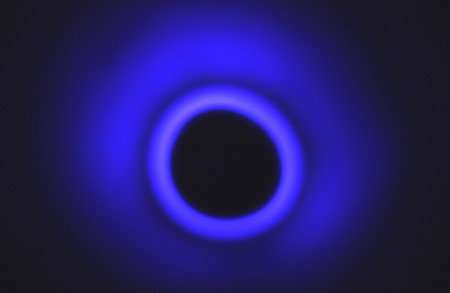
Engineers create stable plasma ring in open air
A torus of plasma, viewed from above. The ring is created by a jet of water striking a crystal plate. Credit: Mory Gharib/Caltech

(ScienceX)—It was a big week for astronomy and astrophysics as an international of researchers working in Mexico used a high-altitude observatory to shed light on the origin of excess anti-matter—they captured the first wide-angle view of gamma rays from two stars that were rapidly spinning. Also, a team with members from Germany, the U.K. and the U.S. announced that they believe gravitational waves from merging supermassive black holes will be spotted within 10 years.

An international team of astronomers discovered a new type of cosmic explosion. Called PS1-10adi—it was 10 times bigger than normal cosmic explosions. Also, a team with members from several institutions in the U.S. announced that experiments with heavy nitrogen molecules revealed a planetary-scale tug-of-war between the Earth, life and the upper atmosphere.

In technology news, a team of engineers created a stable plasma ring in open air showing that it was possible to create plasma with a clearly defined shape. And a team at Texas A&M University took the next step toward fusion energy by developing a material that may be suitable for use in fusion reactors. Also, a team of researchers with several members from the University of Oslo in Norway and one with Monash University in Australia found that it may be fructan, not gluten, that upsets people's stomachs. And a combined team from the University of Michigan and Jiangnan University announced that they had created a Kevlar-based artificial cartilage that mimics the magic of the real thing—possibly paving the way for its use in human joint injuries. And a team with members from several institutions in the U.S. described a new mirror that reflects light differently than conventional mirrors, which might prove useful for information processing and other light-based applications.

And finally, if you are like most people and are interested in finding ways to live longer, you might consider adopting a dog if you do not already have one. A team of researchers in Sweden recently found that dog ownership can be linked to lower mortality. Having a dog, they found, lowers the risk of death due to cardiovascular disease.

© 2017 ScienceX

Citation: Best of Last Week–A new type of cosmic explosion, creating plasma in a defined shape and dogs helping people live longer (2017, November 20) retrieved 5 May 2026 from https://sciencex.com/news/2017-11-weeka-cosmic-explosion-plasma-dogs.html
This document is subject to copyright. Apart from any fair dealing for the purpose of private study or research, no part may be reproduced without the written permission. The content is provided for information purposes only.

Written for you by our author Bob Yirka—this article is the result of careful human work. We rely on readers like you to keep independent science journalism alive. If this reporting matters to you, please consider a donation (especially monthly).

Latest stories

Physics-based weather models more accurate than AI at predicting extreme weather

Weather forecasting is another aspect of modern life that artificial intelligence is transforming. Models like GraphCast, Pangu-Weather, and Fuxi are already better than traditional physics-based climate models at predicting ...

Is fasting the new anti-aging hack? For seniors, it's complicated

Think skipping meals is just for younger folks? Research suggests that when and how older adults eat can influence weight, heart health, and even cognitive function. There's a trade-off, though.

Relamination: A mechanism that has been shaping continents for billions of years

An international team led by researchers from the National Museum of Natural Sciences (MNCN-CSIC) has identified a key mechanism that has shaped Earth's continents over billions of years. This mechanism is the deep re-lamination ...

Nutrient imbalance may drive coral disease more than heat stress

Scientists led by the University of Southampton have revealed that an imbalance of nutrients in seawater can cause coral disease—possibly to a greater extent than that from heat stress of warming oceans. New research conducted ...

Burned stone, child's bones, and lost jewelry hint at prehistoric mining camp high in the Pyrenees

In the past, scientists thought that prehistoric peoples only traveled briefly through high-altitude mountain areas, rather than staying to take advantage of their resources. But new evidence suggests that, starting about ...

A simple physics-inspired model sheds light on how AI learns

Artificial intelligence systems based on neural networks—such as ChatGPT, Claude, DeepSeek or Gemini—are extraordinarily powerful, yet their internal workings remain largely a "black box." To better understand how these systems ...

Politicians are not ignoring you, statistical analysis suggests

If you're registered to vote in the United States and you're not among the richest of the rich, political scientist Peter K. Enns has a message for you: Your voice still matters. So does data analysis methodology.

AI-powered lab discovers brighter lead-free nanomaterials in 12 hours

A new autonomous laboratory recently navigated through billions of potential material synthesis recipes to identify brighter, lead-free light-emitting nanomaterials in just 12 hours. The work could accelerate development ...

Antibiotic-resistant bacteria turn up in six lakes, with urban waters hit hardest

A team of scientists from Berlin analyzed water and sediment samples from six water bodies in Berlin and the adjacent federal states of Brandenburg and Mecklenburg-Western Pomerania, as well as the inflow and outflow of a ...

Climate change increases spillover risk of rodent-borne arenaviruses, study warns

Climate change is likely to drive rodent-borne arenaviruses into parts of South America that have never faced these diseases, putting new communities of people at risk, finds a study from the University of California, Davis. ...