Best of Last Week–Power of quark fusion, alcohol killing brain stem cells and sleep deprivation causing mental problems


Theoretical quark fusion found to be more powerful than hydrogen fusion
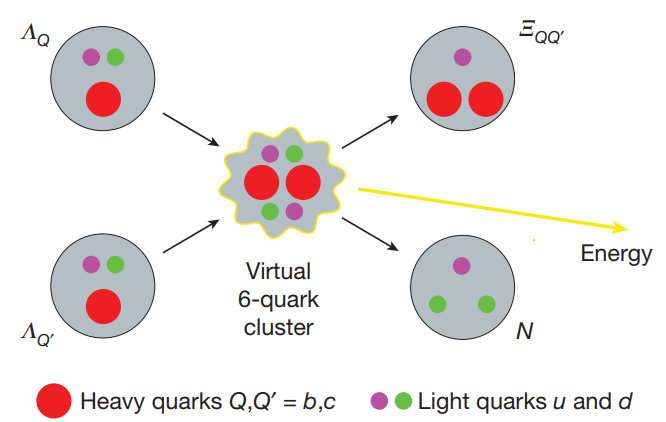
Schematic depiction of quark-level exothermic fusion reactions ΛQΛQ′ → ΞQQ′N, where Q,Q′ ∈ {b, c}. Credit: (c) Nature (2017). DOI: 10.1038/nature24289

(ScienceX)—It was another good week for physics as a pair of researchers with Tel Aviv University and the University of Chicago found that theoretical quark fusion could be more powerful than hydrogen fusion—their study of fusing quarks to make doubly-charmed baryons showed that doing so released more energy than fusing hydrogen atoms. Also, a team of physicists developed a device that could provide conclusive evidence for the existence (or not) of non-Abelian anyons—the device created by the team at UC Santa Barbara was based on graphene, but before it can be used, a means of measuring the quasiparticles must be found. In somewhat related news, officials with IBM said they have a reached milestone in quantum computing—building a working 50 quantum bit processor.

In news regarding planet Earth, a team with NASA conducted a study that bolsters a theory of a heat source under Antarctica—a likely mantle plume deep below Antarctica's Marie Byrd Land. Also, a group of scientists found a potential 'missing link' in the chemistry that led to life on Earth. The team with the Scripps Research Institute identified the compound as diamidophosphate, suggesting it could have been the key ingredient in a phosphorylation chemical reaction. And a pair of researchers with Tohoku University conducting a new analysis of the Chicxulub asteroid suggested it may have struck in a vulnerable spot—an area particularly dense in hydrocarbons.

In other news, a team with the University of Cincinnati discovered a rare Minoan sealstone in the treasure-laden tomb of a Bronze Age Greek warrior in southwest Greece. Also, a team at the University of Texas Medical Branch at Galveston found that frequent alcohol drinking kills new brain cells in adults and that females are more vulnerable to stem cell damage. And a team at Duke University found that Bonobos help strangers without being asked—they conducted experiments that showed that the chimp-like apes were willing to help others get food even if there was no reward in it for them.

And finally, If you are someone burning the midnight oil hoping to get ahead in this world, you might be interested in a study conducted by an international team of researchers who found that sleep deprivation disrupts brain-cell communications, leading to mental and memory lapses and altered perception.

© 2017 ScienceX

Citation: Best of Last Week–Power of quark fusion, alcohol killing brain stem cells and sleep deprivation causing mental problems (2017, November 13) retrieved 3 May 2026 from https://sciencex.com/news/2017-11-weekpower-quark-fusion-alcohol-brain.html
This document is subject to copyright. Apart from any fair dealing for the purpose of private study or research, no part may be reproduced without the written permission. The content is provided for information purposes only.

Written for you by our author Bob Yirka—this article is the result of careful human work. We rely on readers like you to keep independent science journalism alive. If this reporting matters to you, please consider a donation (especially monthly).

Latest stories

New imaging method maps reversed DNA replication forks in single cells

Researchers at The University of Texas MD Anderson Cancer Center have developed a new imaging method, known as RF-SIRF, that quantitatively detects and maps reversed DNA replication forks with single-cell resolution. The ...

Atlantic bluefin's comeback reveals an ocean-spanning mix that could upend how this iconic fish is managed

Atlantic bluefin tuna, the largest of all tuna species, declined precipitously toward commercial collapse in the early 2000s after decades of overfishing. The species has since rebounded across most of its range, a recovery ...

This 'living plastic' activates and self-destructs on command

Many plastic products are designed to be used only once, yet the material itself lasts for years. But a new strategy is addressing this problem by creating products that self-destruct on command, known as living plastics. ...

Blocking a cellular inflammation process could result in effective therapy for pancreatic cancer

Scientists at The Wistar Institute and clinical researchers from ChristianaCare's Helen F. Graham Cancer Center & Research Institute have discovered a vulnerability in pancreatic cancer that could be targeted as a potential ...

A bright moon may dim the Eta Aquarid meteor shower made up of Halley's comet debris

The Eta Aquarid meteor shower soon will light the sky with debris from Halley's comet. But a bright moon will spoil the fun this year, making the display harder to glimpse.

Why Eurovision stays unpredictable after 70 years of copycats and rule changes

The Eurovision Song Contest (ESC) has been attracting millions of fans every year since it was launched back in 1956. At the same time, it represents a unique opportunity for research. Almost no other major cultural event ...

Gold digging is not exclusive to women: New study uncovers common attributes

Gold digging is often seen as a female behavior focused on exploiting wealthier partners for material gain, but science suggests this stereotype may be too narrow. Past studies have shown both men and women value resources ...

Blood vessels activate self-defense response that may slow atherosclerosis progression

A study by researchers at Baylor College of Medicine and collaborating institutions reveals a previously unrecognized way blood vessels can protect themselves from damage and slow the development of atherosclerosis. The findings, ...

Locked in stone for 210 million years, this newly identified crocodile cousin was built to crush larger prey

On a fateful day 210 million years ago, two crocodile cousins about the size of jackals stood side-by-side amid the low ferns of a humid riverbank that would one day become northern New Mexico. One of the crocs, Hesperosuchus ...

Lithium not working? Large-scale study highlights favorable treatment strategies for bipolar disorder

Bipolar disorder is a mental health condition estimated to affect between 1% and 3% of people worldwide. Its main symptoms include extreme mood swings, ranging from periods of high activity and emotional high (i.e., mania) ...