Best of last week: Flux capacitor invented, a better 3-D printer and the true benefits of vitamins

Physicists invent flux capacitor, break time-reversal symmetry
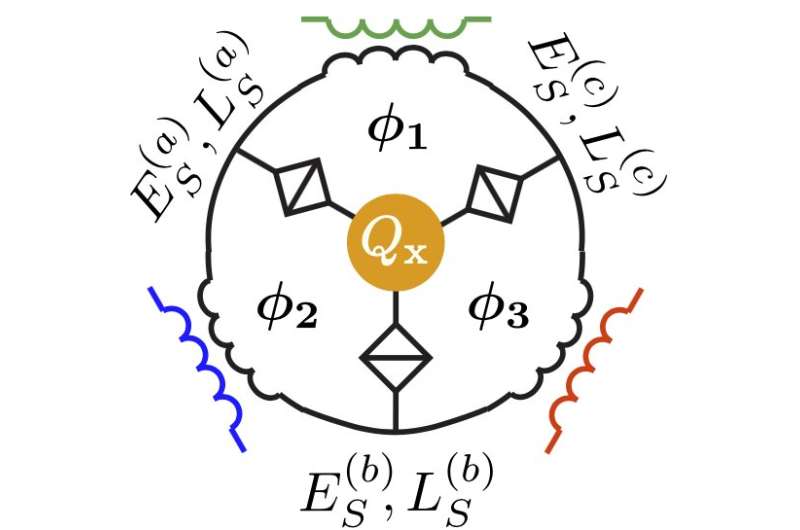
Schematic representation of the proposed circulator. Credit: FLEET

It was a good week for physics as a team with members from Australia and Switzerland invented a flux capacitor able to break time-reversal symmetry. They proposed a device based on quantum tunneling of magnetic flux around a capacitor. And another team with members from across the U.S. reported on a gravitational wave event that likely signaled the creation of a black hole—the merger of two neutron stars.

In biology news, a team of engineers led by Sinisa Vukelic invented a noninvasive technique to correct vision. Like LASIK, it uses lasers but is non-surgical and has few side-effects. And an international team of researchers found what they describe as the mother of all lizards in the Italian Alps, the oldest known lizard fossil, from approximately 240 million years ago. Also, a team at the University of Sydney found that walking faster could make you live longer. People do not even need to walk more, the team reported, they just need to pick up the pace of their normal stride to see an improvement in several health factors. And a team from Cal Poly Pomona discovered how microbes survive clean rooms and contaminate spacecraft—and it involved the cleaning agents themselves.

In other news, a team of researchers from the University of California and the University of Southern Queensland announced that they had identified 121 giant planets that may have habitable moons. And a team at Stanford University found that wars and clan structure might explain a strange biological event that occurred 7,000 years ago—male genetic diversity appeared to collapse for a time. Also, a team of researchers from MIT and Harvard University report the development of a 3-D printer that can print data sets as physical objects—offering far more realistic, nearly true-color renderings.

And finally, if you are someone who has grown accustomed to taking vitamins or other health supplements to maintain good health, you might want to take a look at the work done by a team with members from St. Michael's Hospital and the University of Toronto. They found that most popular vitamin and mineral supplements provide no health benefits.

© 2018 Science X

Citation: Best of last week: Flux capacitor invented, a better 3-D printer and the true benefits of vitamins (2018, June 4) retrieved 22 April 2026 from https://sciencex.com/news/2018-06-week-flux-capacitor-d-printer.html
This document is subject to copyright. Apart from any fair dealing for the purpose of private study or research, no part may be reproduced without the written permission. The content is provided for information purposes only.

Written for you by our author Bob Yirka—this article is the result of careful human work. We rely on readers like you to keep independent science journalism alive. If this reporting matters to you, please consider a donation (especially monthly).

Latest stories

Family environment can shape life outcomes across generations

Adopted children who have grown up in more favorable family environments than their siblings are at lower risk of mental health issues, criminality and social problems, benefits that—in some cases—extend to the next generation. ...

Measuring how stressed rocks 'sigh' before breaking could help predict geohazards

Too much stress can make even a rock crack. But before rocks reach their breaking point, they "sigh" a chemical warning by releasing nuclides, a type of atom defined by the number of neutrons as well as protons in the nucleus. ...

This volcano that 'slept' for 100,000 years was never truly quiet

For more than 100,000 years, the Methana volcano in Greece appeared dormant. No lava, no explosions, no ash clouds. It appeared extinct, like many other volcanoes today. An international research team led by ETH Zurich has ...

Autoantibody map uncovers body-wide immune attacks across Alzheimer's, Parkinson's and MS

Researchers at the University of São Paulo (USP) in Brazil discovered that neurodegenerative diseases, such as Alzheimer's, Parkinson's, and multiple sclerosis, are more complex than previously thought. Their analysis of ...

How a faster protein-screening tool could strengthen US rare-earth supply chains

To ensure a robust domestic supply chain in the U.S., Lawrence Livermore National Laboratory (LLNL) scientists are using bacterial proteins to separate the rare-earth elements that are ubiquitous in magnets, batteries, and ...

Turning four into two: How duplicated genomes become diploid again

Genome duplication probably gave biodiversity a decisive evolutionary boost. A Chinese-German research team led by Axel Meyer from the University of Konstanz has now investigated the early phases of the process known as rediploidization. ...

AI for molecular simulations may not need built-in physics to deliver strong results

Simulating how atoms and molecules move over time is a central challenge in computational chemistry and materials science. Classical machine learning approaches to molecular dynamics (MD) encode fundamental physical principles ...

Tiny satellites face big data limits: How foldable antennas could change CubeSat missions

An origami-inspired reflectarray antenna developed by researchers at Institute of Science Tokyo enables CubeSats to achieve high antenna gain while fitting within the tight size constraints of small satellites. Weighing just ...

HEPA air purifiers may boost brain power in adults over 40

Using an in-home HEPA purifier for one month spurs a small but significant improvement in brain function in adults age 40 and older. That's the result of a new study we co-authored in the journal Scientific Reports.

Ancient amber reveals a true bug equipped with claws, a highly unusual feature

Amber from the Kachin region of Myanmar has preserved a wealth of fossils, offering insights into the diversity of the Cretaceous fauna of a 100-million-year-old forest ecosystem. The site continues to yield previously unknown ...