Best of Last Week – Evidence of matter-matter coupling, no safe level for alcohol and dehydration impact on the brain


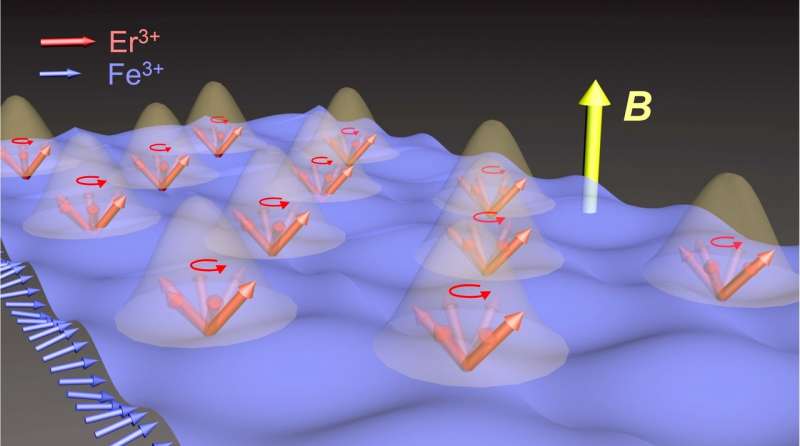
Rice U. lab finds evidence of matter-matter coupling
Rice University scientists observed Dicke cooperativity in a magnetic crystal in which two types of spins, in iron (blue arrows) and erbium (red arrows), interacted with each other. The iron spins were excited to form a wave-like object called a spin wave; the erbium spins precessing in a magnetic field (B) behaved like two-level atoms. Credit: Xinwei Li

It was a good week for physics as an international team of researchers announced that they had found evidence of matter-matter coupling, which they noted could help advance the understanding of spintronics and quantum magnetism. And a team at MIT reported that they had used light from ancient quasars to confirm the idea of quantum entanglement—they used light emitted billions of years ago to measure entangled photons.

In space news, a team with members from Canada and the U.S. discovered that a new kind of aurora is not an aurora at all—photographers alerted scientists to the thin purple and white strips in the sky two years ago. And another team with members from several institutions in the U.S. made headlines when they announced that they had confirmed the existence of ice at the moon's poles.

In technology news, a team at UC Davis announced that they had used machine learning for cross-lingual and cross-platform rumor verification—the system can be used to verify made by online media sites by comparing them actual reporting by other news sites. And a team at North Carolina State University announced that they had compiled a new database of executable Python code snippets on GitHub—making it easier for programmers to find code that they can actually execute on the popular programming site.

In other news, a team with members from the University of Kansas and Oxford University conducted new research on fossil and extant bivalves and gastropods in the Atlantic Ocean, and in so doing, found evidence suggesting thatevolution might favor 'survival of the laziest.' Also, a team led by Emmanuela Gakidou of the University of Washington made headlines around the globe when they announced that they had found that there is no safe level of alcohol consumption. And a team with members from the University of Bristol and University of Bath developed a timescale for the origin and evolution of all of life on Earth.

And finally, if you have found yourself struggling mentally after doing some exercise, you might be able to trace it back to how much water you drank—a team at Georgia Institute of Technology found that dehydration alters human brain shape and activity and can slacken task performance.

© 2018 Science X

Citation: Best of Last Week – Evidence of matter-matter coupling, no safe level for alcohol and dehydration impact on the brain (2018, August 27) retrieved 27 April 2026 from https://sciencex.com/news/2018-08-week-evidence-matter-matter-coupling-safe.html
This document is subject to copyright. Apart from any fair dealing for the purpose of private study or research, no part may be reproduced without the written permission. The content is provided for information purposes only.

Written for you by our author Bob Yirka—this article is the result of careful human work. We rely on readers like you to keep independent science journalism alive. If this reporting matters to you, please consider a donation (especially monthly).

Latest stories

Drugging the undruggable: Cancer's slipperiest targets finally meet their match

Researchers at the University of British Columbia and BC Cancer have developed a new way to target proteins long considered "undruggable," opening the door to new treatments for prostate cancer and other serious diseases. ...

An unprecedented Antarctic heat wave hit in the dead of winter—what it signals for the decades ahead

In the middle of the Antarctic winter, during months of darkness when temperatures often dip below −30°C, the continent warmed dramatically. In July and August 2024, temperatures in parts of East Antarctica rose by up to ...

Room-temperature vibrations could transform how industry makes graphene

Researchers have demonstrated a new technique for creating 2D materials that runs at room temperature and increases production rates tenfold over current methods, without using toxic solvents. Scientists led by Dr. Jason ...

California's most iconic trees are entering a silent collapse that could remake forests, rangelands and coastlines

From the scarecrow-like silhouettes of Joshua Tree National Park to the fog-shrouded Redwood Coast of Mendocino and Humboldt counties, California's identity is deeply rooted in its trees. However, a new study led by researchers ...

This ultracold quantum device turns electricity into something far stranger that could unlock sound-based lasers

Researchers at McGill University have developed a novel device that generates sound-like particles known as phonons at extremely cold temperatures. The technology could be used to create phonon lasers, with possible applications ...

Sewers have been hiding a climate problem in plain sight, and this new tool finally exposes its true scale

Methane is the second-largest greenhouse gas after carbon dioxide. According to the Climate and Clean Air Coalition, anthropogenic methane emissions account for nearly 45% of current net warming, making it an important factor ...

Simulations predict ground motion for earthquakes on Bay Area's Hayward fault

The Hayward fault, part of the larger San Andreas fault system, runs 74 miles through the East Bay of the San Francisco Bay Area. The fault is overdue for an earthquake that could cause extensive damage to such a dense population ...

Light-based scans reveal how cells can be stable yet adaptable

Our cells adjust to ever-changing conditions while preserving internal states necessary for survival, but exactly how they achieve both adaptability and stability remains unclear. For the first time, researchers have used ...

Minimally invasive procedure outperforms drugs for advanced atrial fibrillation

A minimally invasive heart procedure may be a better first-line treatment than medication for people living with advanced forms of atrial fibrillation, according to a major international clinical trial led by researchers ...

Fragile no more, nickelates get an upgrade that changes how superconductivity endures

Discovered in 2019, the material known as nickelates has intrigued researchers for its potential to become a superconductor at elevated temperatures—a property that could significantly advance such fields as quantum science ...