Best of Last Week – Sun in a box, new dark matter theory and metabolism boost after exercise lasts longer than thought


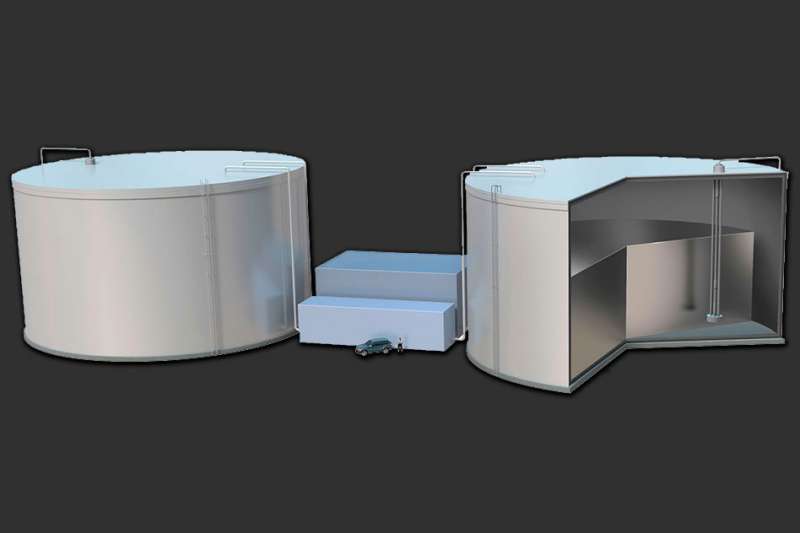
'Sun in a box' would store renewable energy for the grid
MIT researchers propose a concept for a renewable storage system, pictured here, that would store solar and wind energy in the form of white-hot liquid silicon, stored in heavily insulated tanks. Credit: Duncan MacGruer

It was a good week for technology as a team at MIT unveiled what they described as a 'sun in a box' to store renewable energy for the grid—it is based on storing excess electricity collected from solar cells and wind farms in large tanks of white-hot molten silicon. Also, a team at the MIT Media Lab described building a plant cyborg that could move toward a preferred light source—they put the plant on a wheeled base with electronics that converted plant communications to movement commands. And Till Hartman, from Harvard Medical School, carried out a study to improve computer vision in the dark using classical convolution neural networks. Also, a team that included members from Caltech, NASA's Jet Propulsion Laboratory, the Honda Research Institute and Lawrence Berkeley National Laboratory outlined a new battery concept based on fluoride ions that may increase battery lifespans.

There were also a couple of stories that made headlines around the world. In the first, a team at the University of Oxford suggested they may have solved one of the biggest questions in physics: What is the nature of dark matter? They came up with a new theory that could explain the missing 95 percent of the cosmos by unifying dark matter with dark energy as a fluid that possesses negative mass. And a study by researchers from Yale University of Oviedo in Spain, the Galapagos Conservancy and the Galapagos National Park Service reported that the death of Lonesome George may have helped reveal the mystery of why giant tortoises live so long.

In other news, University of Kent researcher Robin Mackenzie explored the ethical implications of creating sentient and self-aware sexbots in considerable detail and discovered there may be more at stake than previously thought. And a team at the Institute for Research in Immunology and Cancer at Université de Montréal announced a major breakthrough in the quest for a cancer vaccine. Also, an international team of space scientists reported on the detection of the biggest known black-hole collision to date.

And finally, if you are worried that taking a day or two off from your fitness routine will ruin your efforts, you may not need to worry—a team at UT Southwestern Medical Center found that a single workout can your boost metabolism for days.

© 2018 Science X Network

Citation: Best of Last Week – Sun in a box, new dark matter theory and metabolism boost after exercise lasts longer than thought (2018, December 10) retrieved 25 April 2026 from https://sciencex.com/news/2018-12-week-sun-dark-theory-metabolism.html
This document is subject to copyright. Apart from any fair dealing for the purpose of private study or research, no part may be reproduced without the written permission. The content is provided for information purposes only.

Written for you by our author Bob Yirka—this article is the result of careful human work. We rely on readers like you to keep independent science journalism alive. If this reporting matters to you, please consider a donation (especially monthly).

Latest stories

Microfluidic device tracks cell 'squishiness' faster and more reliably than standard methods

Researchers from Brown University and their collaborators have developed a new way to measure the properties of cells—an important development, they say, because accurate measurements of changes in cell elasticity can be ...

Fluorescent probe lights up centrioles and cilia in living cells across species

Scientists at EPFL have developed CenSpark, a fluorescent probe that makes centrioles and cilia visible inside living cells, helping researchers study cell division, development, and immunity like never before.

Scientists transform wool into bone repair material

Scientists have shown how wool could offer an effective and sustainable alternative to materials currently used to repair damaged bone. In the new study, keratin—a natural structural protein derived from wool—was shown to ...

When the rain comes, some NYC subway riders stay home. Scientists are now mapping exactly who, and where

On a sweltering August afternoon or in the teeth of a winter storm, New York City subway riders make a quiet calculation: Is the trip worth it? A new study published in npj Sustainable Mobility and Transport takes a detailed ...

Depression treatment is shifting, and this mushroom-derived compound is driving one of psychiatry's biggest new tests

Depression is a debilitating mental health disorder that is estimated to affect approximately 5% of people worldwide. It is characterized by persistent feelings of sadness and hopelessness, a lack of interest in everyday ...

Before dinosaurs vanished, a hamster-sized mammal was already shaping what survived next on the Pacific Coast

Mammals and dinosaurs coexisted on Earth until a catastrophic event 66 million years ago killed 75% of life on the planet. Despite the devastation, some animals survived, including rodent-like mammals in the Cimolodon genus. ...

HIV disrupts lung 'clock,' raising COPD and emphysema risk

People living with HIV face a greater risk of developing lung diseases at a much younger age, even if they have never smoked. FIU researchers have now uncovered a previously unknown mechanism that helps explain how HIV causes ...

More activity means less response in active materials

For some time, researchers have assumed that solid materials could gain more useful properties by making their microscopic components more active. Now, a team led by Jack Binysh at the University of Amsterdam has found that ...

This life‑threatening bacterium's hidden motor just gave medicine an unexpected opening to fight back

Scientists have mapped in unprecedented detail the structure of Vibrio bacteria, which can cause life-threatening infections linked to antibiotic resistance. The King's College London team behind the study, published in Nature ...

Studying the emergence of leaders in moving crowds of pedestrians

When humans are moving as a crowd, their movements tend to be highly coordinated, similarly to the collective motions of bird flocks or other groups of animals. These group behaviors can limit collisions in dynamic environments, ...