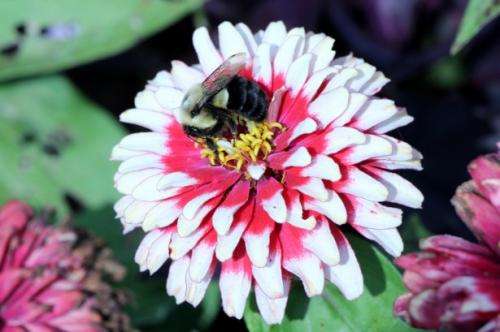
Researchers find bee species where males perform babysitting duties


bee
Credit: Lilla Frerichs/public domain

A team of researchers with Charles University and the Czech Academy of Science has discovered a species of bee where males guard a nest while females are off gathering food for their young. In their paper published in Proceedings of the National Academy of Sciences, the group describes their study of Ceratina nigrolabiata and what they found.

Ceratina nigrolabiata, small bluish-black bees live around the Mediterranean Sea. They are somewhat unique in that they do not build nests with large numbers of taking care of a queen, while drones are off gathering food. Instead, a female builds a small inside the stem of a plant where she lays her eggs. Once they hatch, she becomes the lone provider, flying about gathering nectar to bring back to feed her young. The species is unique in another way—when the mothers go off foraging, that are not even the father of the young stand guard, protecting the young bees in their mother's absence. In observing the bees, the researchers found that the work by the males was not exactly an act of kindness—doing so gave them a strong chance of mating with the female.

In all, the researchers studied 78 nests, watching each for a period of an hour and a half. They report that in the majority of cases, a male resided in the nest with the female—when she went off to forage, the male placed himself in the doorway, blocking predators (mainly ants) from entering. When the female returned with a load of pollen, the male allowed her into the nest and continued to stand guard while she fed the young. The researchers tested the males by putting ants on the nests—in most cases, the males blocked them from entering the nests. In more extreme cases they actually pushed the ants out of the nest. The researchers also found that the longer the male inhabited the nest, the more likely he was to mate and produce female offspring (unfertilized eggs grow into males). The researchers note that their discovery was the first ever of male bees performing babysitting duty.

Publication details

Michael Mikát et al. Polyandrous bee provides extended offspring care biparentally as an alternative to monandry based eusociality, Proceedings of the National Academy of Sciences (2019). DOI: 10.1073/pnas.1810092116

© 2019 Science X Network

Citation: Researchers find bee species where males perform babysitting duties (2019, March 18) retrieved 30 April 2026 from https://sciencex.com/news/2019-03-bee-species-males-babysitting-duties.html
This document is subject to copyright. Apart from any fair dealing for the purpose of private study or research, no part may be reproduced without the written permission. The content is provided for information purposes only.

Written for you by our author Bob Yirka—this article is the result of careful human work. We rely on readers like you to keep independent science journalism alive. If this reporting matters to you, please consider a donation (especially monthly).

Latest stories

Compound in ginger and turmeric may disarm drug-resistant bacteria

Every year, antibiotic-resistant Staphylococcus aureus, commonly known as staph, causes serious infections and outbreaks in hospitals and community settings, disproportionately affecting vulnerable populations, including ...

Feeding shift may have steered 55 pilot whales toward Scotland mass stranding

New research, focused on the feeding behavior of long-finned pilot whales, has shed light on one of Scotland's largest mass stranding events. The study, led by the Scottish Marine Animal Stranding Scheme (SMASS) based at ...

Fungi utilize ancient antimicrobial proteins to attack hosts and their microbiomes, plant researchers discover

An international research team led by Cologne-based plant scientist Professor Dr. Bart Thomma from the Institute for Plant Sciences, the Collaborative Research Center MiBiNet and the CEPLAS Cluster of Excellence for Plant ...

Laser-plasma accelerators can preserve polarization of Helium-3 ions

Particle accelerators such as those at the European Organization for Nuclear Research (CERN) in Geneva are typically highly complex large-scale devices. In these ring-shaped facilities, which are often several kilometers ...

Communication from the CDC fuels skepticism about vaccines and science, research suggests

The scientific consensus is that vaccinations are neither causally nor statistically linked to autism. The US health authority CDC changed its official communication on this matter and instead emphasized a connection could ...

Evolution has reused the same genes for 120 million years, study shows

Scientists have shown that evolution has been using the same genetic "cheat sheet" for over 120 million years, suggesting that life on Earth may be more predictable than first imagined. The international team, led by scientists ...

Wild parrots quickly learn to eat new foods by copying their friends

Wild parrots learn whether new types of food are safe to eat by observing other members of their social group, allowing dietary knowledge to spread rapidly through the community, according to a study by Julia Penndorf at ...

In good spirits: Why haunted houses are perfect places to connect with others

A pounding heart, shaking limbs, chills and a churning stomach—it's no wonder that fear is an emotion we usually try to avoid. At least most of the time. We may not like having the wits scared out of us in a real-life crisis, ...

Kangaroos chart 'upside-down' evolution

New research led by Flinders University argues thick tooth enamel helped kangaroos chart an unconventional evolution story, compared to the animals of other continents. A 50-million-year natural "experiment" among Australia's ...

Hidden 3D atomic structure of relaxor ferroelectrics revealed for first time

Materials called relaxor ferroelectrics have been used for decades in technologies like ultrasounds, microphones, and sonar systems. Their unique properties come from their atomic structure, but that structure has stubbornly ...