Introducing Australotitan: Australia's largest dinosaur yet spanned the length of 2 buses


Introducing Australotitan: Australia's largest dinosaur yet spanned the length of 2 buses
Credit: Vlad Konstantinov, Scott Hocknull, Eromanga Natural History Museum, Author provided

Today, a new Aussie dinosaur is being welcomed into the fold. Our study published in the journal PeerJ documents Australotitan cooperensis—Australia's largest dinosaur species ever discovered, and the largest land-dwelling species to have walked the outback.

Australotitan, or the "southern titan", was a massive long-necked titanosaurian sauropod estimated to have reached 25–30 metres in length and 5–6.5m in height. It weighed the equivalent of 1,400 red kangaroos.

It lived in southwest Queensland between 92–96 million years ago, when Australia was attached to Antarctica, and the last vestiges of a once-great inland sea had disappeared.

The discovery of Australotitan is a major new addition to the "terrible lizards" of Oz.

Like finding needles in haystack

Finding dinosaurs in Australia has been labelled an incredibly difficult task.

In outback Queensland, dinosaur sites are featureless plains. Compare that to many sites overseas, where mountain ranges, deep canyons or exposed badlands of heavily-eroded terrain can help reveal the ancient layers of preserved fossilised bones.

Today, the area where Australotitan lived is oil, gas and grazing country. Our study represents the first major step in documenting the dinosaurs from this fossil field.

The first bones of Australotitan were excavated in 2006 and 2007 by Queensland Museum and Eromanga Natural History Museum palaeontologists and volunteers. We nicknamed this individual "Cooper" after the nearby freshwater lifeline, Cooper Creek.

After the excavation, we embarked on the long and painstaking removal of the rock that entombed Cooper's bones. This was necessary for us to properly identify and compare each bone.

Introducing Australotitan: Australia's largest dinosaur yet spanned the length of 2 buses
Australotitan cooperensis was the largest dinosaur species to have walked outback Australia.

Thousands of kilograms bones in a backpack

We needed to compare Cooper's bones to all other species of sauropod dinosaur known from both Australia and overseas, to confirm our suspicions of a new species.

But travelling from collection to collection at various museums to compare hundreds of kilograms of fragile dinosaur bones was simply not possible. So instead, we used 3D digital scanning technology which allowed us to virtually carry thousands of kilograms of dinosaur bones in one seven kilogram laptop.

These kinds of research projects have created a new opportunity for museums and researchers to share their amazing collections globally, with researchers and the public.

And thanks to two decades of effort by palaeontologists, citizen scientists, regional not-for-profit museums and local landowners, there has been a recent boom in Australian dinosaur discoveries.

Introducing Australotitan: Australia's largest dinosaur yet spanned the length of 2 buses
From Dig to Digital Dinosaurs! 3D scanning technology allows researchers an unprecedented way to compare fossilised bones of enormous dinosaurs, and view these digital replicas virtually. Credit: S. Hocknull & R. Lawrence, Queensland Museum

We are family

Perhaps unsurprisingly, we found all four of the sauropod dinosaurs that lived in Australia between 96-92 million years ago (including Australotitan) were more closely related to one another than they were to other dinosaurs found elsewhere.

However, we couldn't conclusively place any of these four related species together in the same place at the same time. This means they could have evolved through time to occupy very different habitats. It's even possible they ever met.

The Aussie species share relations with titanosaurians from both South America and Asia, suggesting they dispersed from South America (via Antarctica) during periods of global warmth.

Or, they may have island-hopped across ancient island archipelagos, which would eventually make up the present-day terrains of Southeast Asia and the Philippines.
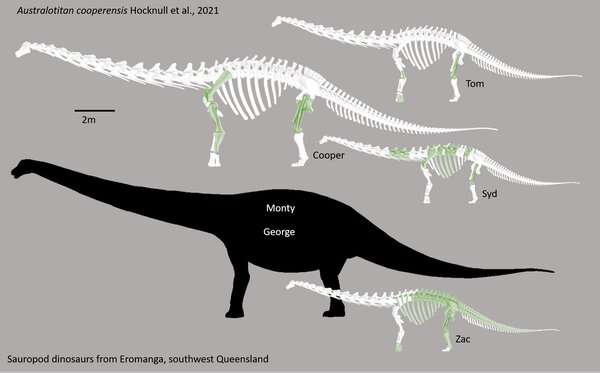
Introducing Australotitan: Australia's largest dinosaur yet spanned the length of 2 buses
Meet the Eromanga sauropods. Green bones represent what parts of the skeleton have so far been discovered. Credit: S. Hocknull, Queensland Museum

Trampling through the Cretaceous

Digitally capturing gigantic sauropod bones and fossil sites in 3D has led to some remarkable discoveries. Several of Cooper's bones were found to be crushed by the footsteps of other sauropod dinosaurs.

What's more, during Cooper's excavation we uncovered another smaller sauropod skeleton—possibly a smaller Australotitan—trampled into a nearly 100m-long rock feature. We interpreted this to be a trample zone: an area of mud compressed under foot by massive sauropods as they moved along a pathway, or at the edge of a waterhole.
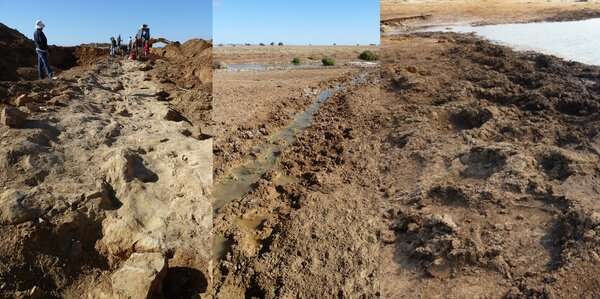
Introducing Australotitan: Australia's largest dinosaur yet spanned the length of 2 buses
A sauropod trample zone (left) compared to a cattle trample (centre) and elephant trample (right). Credit: S. Hocknull & R. Lawrence, Queensland Museum & Eromanga Natural History Museum

Similar trampling features can be seen today around Australian billabongs, or waterholes in Africa where the largest plant-eaters, such as elephants and hippopotamuses, trample mud into a hard layer.

In the case of the hippopotamus, they cut channels through the mud to navigate between precious water and food sources. Life in Australia during the Cretaceous period can be pictured similarly, except super-sized.

In the present, out there in Australia's dinosaur country, you might find yourself staring across a barren plain imagining what other secrets this world of long-lost giants will reveal.

Publication details

Scott A. Hocknull et al, A new giant sauropod, Australotitan cooperensis gen. et sp. nov., from the mid-Cretaceous of Australia, PeerJ (2021). DOI: 10.7717/peerj.11317

This article is republished from The Conversation under a Creative Commons license. Read the original article.The Conversation

Citation: Introducing Australotitan: Australia's largest dinosaur yet spanned the length of 2 buses (2021, June 7) retrieved 30 April 2026 from https://sciencex.com/news/2021-06-australotitan-australia-largest-dinosaur-spanned.html
This document is subject to copyright. Apart from any fair dealing for the purpose of private study or research, no part may be reproduced without the written permission. The content is provided for information purposes only.

Latest stories

Frozen-in gravity: A new way to understand the evolution of spacetime dynamics

The concept of spacetime, first described in Einstein's theory of general relativity, has since been widely studied by many physicists worldwide. Spacetime is described mathematically as a four-dimensional (4D) continuum ...

Buried in soil, a 100-million-year-old bacterial toxin could reshape pest control and antibiotic discovery

In every backyard, park, and playground on Earth, the ground is teeming with a type of bacteria called Streptomyces—one of the most abundant organisms on the planet. While these dirt-dwelling microbes are known for producing ...

Overlooked 'in-between' materials could reshape solar fuel and battery design

Researchers have identified previously unknown materials, including a new form of a widely studied clean-energy material, by carefully controlling and tracking how molecular precursors break down during heating.

Glucose levels appear to guide when brain cells divide or form myelin

Researchers at the Advanced Science Research Center at the CUNY Graduate Center (CUNY ASRC) have uncovered a surprising link between low brain sugar levels and the development of myelin—the protective coating that allows ...

Epilepsy 'brain blips' can be predicted a full second early with neuron-level probes

Epilepsy is best known for seizures, but many people with the condition also experience much more frequent and subtler disruptions. These brief bursts of abnormal brain activity, called interictal epileptiform discharges ...

Snow cover on Greek mountains has more than halved in four decades, study finds

Snow cover in the mountains of Greece—an important water source for communities, agriculture and natural ecosystems during the dry summer months—has more than halved over the past four decades, a study has found.

New genome editing method could swap entire genes and correct 1000 mutations at once

New technology enables the insertion of a large segment of DNA into a genome, potentially expanding gene therapy treatment from cancellation of disease-causing mutations to replacement of an entire gene, scientists say.

AI classifier flags bird flu genomes more likely to spread in mammals

A research team from the LKS Faculty of Medicine at the University of Hong Kong (HKUMed) has developed a machine-learning classifier capable of analyzing the genomes of influenza A viruses (IAVs) to accurately predict their ...

Pet cats that roam outdoors can carry similar disease risk as feral cats

A new study led by University of British Columbia researchers has found that pet cats allowed to roam outside unsupervised carry infectious diseases at rates comparable to feral cats, even when they receive veterinary care, ...

Tokamak regime sustains stable fusion plasma for one minute while easing heat loads

For the first time, a research team has demonstrated, in a metal-wall environment, a plasma regime that simultaneously achieves partial divertor detachment, an edge-localized-mode (ELM)-free high-confinement mode (H-mode), ...