Evolutionary study suggests prehistoric human fossils 'hiding in plain sight' in Southeast Asia

Island Southeast Asia has one of the largest and most intriguing hominin fossil records in the world. But our new research suggests there is another prehistoric human species waiting to be discovered in this region: a group called Denisovans, which have so far only been found thousands of kilometers away in caves in Siberia and the Tibetan Plateau.
Our study, published in Nature Ecology and Evolution, reveals genetic evidence that modern humans (Homo sapiens) interbred with Denisovans in this region, despite the fact Denisovan fossils have never been found here.
Conversely, we found no evidence that the ancestors of present-day Island Southeast Asia populations interbred with either of the two hominin species for which we do have fossil evidence in this region: H. floresiensis from Flores, Indonesia, and H. luzonensis from Luzon in the Philippines.
Together, this paints an intriguing—and still far from clear—picture of human evolutionary ancestry in Island Southeast Asia. We still don't know the precise relationship between H. floresiensis and H. luzonensis, both of which were distinctively small-statured, and the rest of the hominin family tree.
And, perhaps more intriguingly still, our findings raise the possibility there are Denisovan fossils still waiting to be unearthed in Island Southeast Asia—or that we may already have found them but labeled them as something else.
An ancient hominin melting pot
Stone tool records suggest that both H. floresiensis and H. luzonensis are descended from Homo erectus populations that colonized their respective island homes about 700,000 years ago. H. erectus is the first ancient human known to have ventured out of Africa, and has first arrived in Island Southeast Asia at least 1.6 million years ago.
This means the ancestors of H. floresiensis and H. luzonensis diverged from the ancestors of modern humans in Africa around two million years ago, before H. erectus set off on its travels. Modern humans spread out from Africa much more recently, probably arriving in Island Southeast Asia 70,000-50,000 years ago.
We already know that on their journey out of Africa about 70,000 years ago, H. sapiens met and interbred with other related hominin groups that had already colonized Eurasia.
The first of these encounters was with Neanderthals, and resulted in about 2% Neanderthal genetic ancestry in today's non-Africans.
The other encounters involved Denisovans, a species that has been described solely from DNA analysis of a finger bone found in Denisova Cave in Siberia.
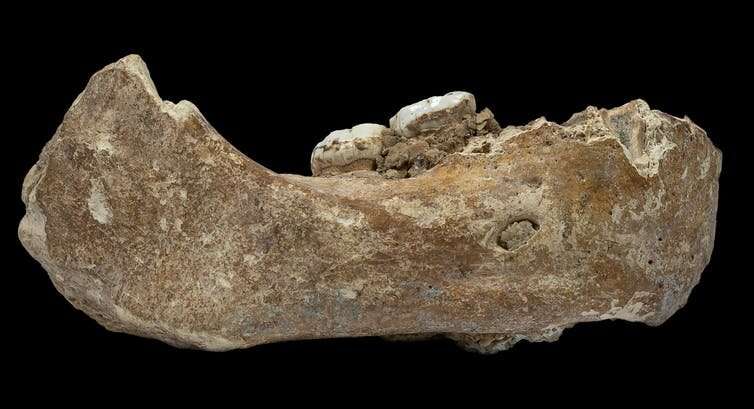
Intriguingly, however, the largest amounts of Denisovan ancestry in today's human populations are found in Island Southeast Asia and the former continent of Sahul (New Guinea and Australia). This is most likely the result of local interbreeding between Denisovans and modern humans—despite the lack of Denisovan fossils to back up this theory.
To learn more, we searched the genome sequences of more than 400 people alive today, including more than 200 from Island Southeast Asia, looking for distinct DNA sequences characteristic of these earlier hominin species.
We found genetic evidence the ancestors of present-day people living in Island Southeast Asia have interbred with Denisovans—just as many groups outside Africa have similarly interbred with Neanderthals during their evolutionary history. But we found no evidence of interbreeding with the more evolutionarily distant species H. floresiensis and H. luzonensis (or even H. erectus).
This is a remarkable result, as Island Southeast Asia is thousands of kilometers from Siberia, and contains one of the richest and most diverse hominin fossil records in the world. It suggests there are more fossil riches to be uncovered.
So where are the region's Denisovans?
There are two exciting possibilities that might reconcile our genetic results with with the fossil evidence. First, it's possible Denisovans mixed with H. sapiens in areas of Island Southeast Asia where hominin fossils are yet to be found.
One possible location is Sulawesi, where stone tools have been found dating back at least 200,000 years. Another is Australia, where 65,000-year-old artifacts currently attributed to modern humans were recently found at Madjebebe.
Alternatively, we may need to rethink our interpretation of the hominin fossils already discovered in Island Southeast Asia.
Confirmed Denisovan fossils are extremely rare and have so far only been found in central Asia. But perhaps Denisovans were much more diverse in size and shape than we realized, meaning we might conceivably have found them in Island Southeast Asia already but labeled them with a different name.
Given that the earliest evidence for hominin occupation of this region predates the divergence between modern humans and Denisovans, we can't say for certain whether the region has been continuously occupied by hominins throughout this time.
It might therefore be possible that H. floresiensis and H. luzonensis (but also later forms of H. erectus) are much more closely related to modern humans than currently assumed, and might even be responsible for the Denisovan ancestry seen in today's Island Southeast Asia human populations.
If that's true, it would mean the mysterious Denisovans have been hiding in plain sight, disguised as H. floresiensis, H. luzonensis or H. erectus.
Solving these intriguing puzzles will mean waiting for future archeological, DNA and proteomic (protein-related) studies to reveal more answers. But for now, the possibilities are fascinating.
